Four tips for an easier Christmas

By planning ahead, you’ll be able to relax over the holidays rather than teetering under the pressure

Joy bells may ring out from the speakers, but many of us experience stress during the Christmas period. According to Relationships Australia, 93.5% of people celebrate Christmas. And more than 30% experience high levels of stress and anxiety1.

Family and financial pressures

Many people report family relationships as highly stressed due to financial worries and work-life balance factors, while the pressures of buying gifts and entertaining2 also add to the strain. With food and presents being the main expenses, 25% of people worry about covering the costs3.

Four tips for easing into Christmas

While for many families Christmas is a time of giving, it’s important not to give to others at the expense of your own peace of mind. But it’s true that finding the balance can be challenging.

Whether you’re involved in family celebrations or gatherings with friends or colleagues, use our tips to find the right balance for you:

1. Make plans with a birds-eye view

Before all is said and done, create a timeline so you don’t end up doing your shopping or entertaining all at once. Writing down commitments or objectives can go a long way towards relieving the overwhelming feeling that Christmas can bring. Start with a list of bullet points and expand your plan to include dates and action items.

If you feel pressured by family arrangements, visualise the things you’d like to be doing and aim to find a way to achieve them. Sometimes a tactful conversation with family members can help more than you might think.

2. Work out where your Christmas spending money will come from

It’s important to live within your means at Christmas time, even if the lure of giving or family expectations urge you to spend.

  • Work out whether you’re able to allocate money to your Christmas budget. Remember to factor in any unexpected costs that may come your way.
  • Use AMP’s Budget planner calculator to work out how much you may be able to allocate for Christmas spending, and consider whether opening an account like the AMP Bett3r account is right for you—it can help you to plan to pay, save and spend this Christmas.

3. Be a calculated shopper so you’re not tempted to overspend

Once you’ve decided how much you can afford to spend, avoid impulse buying by being financially organised.

  • Set a budget and stick to it.
  • Make a Christmas gift list and include a budget for each person you’ll buy a present for. Keep it handy for next year to save yourself time—you can always tweak it if you need to.
  • When it comes to shopping for food, be sure to find the cheapest prices in the supermarket. You could save more than you think.
  • Shop online before buying and compare prices—the earlier you plan ahead the more time you’ll have for things to arrive by post. You’ll keep your stress levels down by avoiding crowded shopping zones too.
  • Don’t shop with your credit card unless you can pay the balance in full within the interest-free period—20% of Australians paid for Christmas presents with a credit card4 and the average amount owing after festivities is $1,668 per card5.

4. Get creative and have fun in the process!

Can you make gifts and decorations this year? You may decide to make homemade food or other things to give away. Maybe your family members would like to be involved. Can you start a new tradition and have a Christmas making day and spend creative time together?

Enjoy a restful break

In the lead up to Christmas you still have time to get organised and make the most of any time off you have. Use our tips to start planning now so you can keep your costs down, enjoy yourself and welcome in a happy and prosperous 2017!

1, 2 Relationships Australia, December 2015: Christmas stress
3 Survey results reported in The Sydney Morning Herald, One-quarter of people fret about festive season expenses
4 ASIC’s Money Smart, Australia’s Christmas spending
5 Finder.com.au: How Aussies can repay their $286 million credit card interest Christmas debt with a balance transfer
7 trips where you’ll pay next to nothing for accommodation

You don’t always need lots of money to venture to new places.

One of the most expensive parts about travelling is typically what you’ll spend on accommodation.

To reduce or even eliminate your lodging costs, we’ve pulled together seven ideas that could open you up to a world of possibilities.

1. Bunk with mates or relatives

If you have friends and family that live interstate, overseas or places you haven’t been before, get in touch and see if they have a room free at their place at a time when you’re both available.

It’ll give you a chance to catch up as well as having an in-house tour guide who can show you the sites, the local attractions, the hidden gems, not to mention the best places to eat.

2. House-sit your way around the globe

Minding someone’s place for free can be a win-win for all parties involved, particularly when the homeowner has pets or various odd jobs that need attending to, which can often be the case.

If you can’t find anyone in your immediate network, you could pay a small subscription fee to register your profile on a relevant house-sitting website like HouseCarers or TrustedHousesitters.

3. Swap accommodation

It’s simple—you go to theirs, they come to yours and it’s free. Another bonus is size doesn’t matter. You can swap your apartment for a beach house in Mexico or even a small studio in New York City.

A few websites where you can check out places to stay and create an online profile for a monthly fee include Love Home Swap and HomeExchange.

4. Volunteer your skills overseas

Getting involved in a humanitarian, environmental or wildlife project abroad is another way you can see the world, offer your services and play a part in something you’re likely to never forget.

Such expeditions will come with varying price tags, but depending on the program you choose there will be a variety of inclusions which may involve flights, meals, accommodation and cultural activities.

Whatever you choose, like most things it’s a good idea to do your research and read the fine print. Websites you may want to check out include International Volunteer HQ and Projects Abroad.

5. Barter your time and hard work

If volunteering isn’t your thing, but you’re open to a working holiday and taking a position where you exchange your services for free or cheap food and accommodation, there’s something for you too.

The types of positions and industries you can work in vary a lot—think fruit picker in outback Australia, bartender in Ireland, tourist operative in a Canadian ski resort.

The amount of hours you work will differ, so again it’s worth doing your research and seeing what’s available. Look at websites like Global Work and Travel and Willing Workers On Organic Farms.

6. Have a stay-at-home vacation

A holiday in your own hood could open you up to possibilities you previously didn’t have time for, or knew existed. It may involve local attractions, coastal walks, a road trip, camping—anything you don’t do day-to-day. The point is breaking away from your usual routine.

Other things to consider

Remember that not everything that’s fun and life changing comes with an unrealistic price tag. And, with 211,000 Australian travellers taking 12 months to pay off their holiday credit card debt1, hopefully some of these money-saving travel ideas have given you some food for thought.

1 https://www.finder.com.au/press-release-debt-lag-2015

Cash is king over the counter at Christmas

See how you can keep your shopping habits in check.

By Paul Clitheroe

The festive season is just around the corner, and plenty of us will be hitting the stores to stock up for Christmas. Research shows we’ll collectively splurge $9.77 billion on gifts alone this year – that’s about $539 for each of us, and this doesn’t include turkey and all the trimmings. So it’s worth thinking about how you’ll manage the cash squeeze to avoid hitting the New Year strapped for cash or weighed down by debt.

Christmas is a wonderful time of year but it can also put extra demands on our finances. Getting in early for festive shopping lets you stagger spending over time, which can make things more manageable.

Some very enthusiastic shoppers are doing just that. Research by Finder shows more than five million Australians started their Christmas shopping in October 2016 or earlier. The real shopping frenzy is expected to peak in early December.

The usual rules of smart shopping apply at Christmas – shop around for a good deal; draw up a purchase list to avoid impulse buys; and hold onto receipts in case Aunty Ethel isn’t so keen on the power tools you’re planning to put in her Christmas stocking this year.

Important rules also apply to the way we make purchases. In particular, aim to pay with cash or a debit card. It’s easy to get caught up in all the pre-Christmas sales and go overboard with spending, however sticking to cash wherever possible means you shouldn’t get into too much trouble.

If you don’t have the cash, consider lay-by. It may be old fashioned but it’s a perfectly acceptable way of buying, and with most retailers you’ll pay no extra charges.

A big incentive to choose cash over a credit card is that you’ll avoid interest costs – an extra expense that can take the shine off a bargain very quickly.

Figures from the MoneySmart website show last year the majority of Australians dipped into savings to pay for Christmas buys. However one in five of us relied on credit cards. The majority (80%) of these people paid the purchases off within three months, but the rest took as long as six months to pay down the card debt. Who wants to still be paying off Christmas in June?

If you need to reach for a credit card think about whether it’s really the right purchase for you – especially if you’re already juggling ongoing card debt. Aim to rely on the folding stuff instead, and don’t be afraid to ask if a cash sale will score an extra discount.

Paul Clitheroe is a founding director of financial planning firm ipac, Chairman of the Australian Government Financial Literacy Board and chief commentator for Money Magazine.

Paul Clitheroe is a founding director of financial planning firm ipac, Chairman of the Australian Government Financial Literacy Board and chief commentator for Money Magazine.

PATRICK CRONIN’S FUNERAL

You may have heard about the tragic loss of Pat Cronin, son of Matt and Robyn Cronin (part owners of Tailored Lifetime Solutions). Pat died on Monday the 18th of April, 2016.

A Funeral Service to honour the life of Mr Patrick John Cronin, will be held at Whitefriars College, 156 Park Rd, Donvale on WEDNESDAY (Apr. 27, 2016) commencing at 10.30 a. m. and after at Lower Plenty Football Club, Para Rd Montmorency.. In lieu of flowers, donations can be made to the Pat Cronin Foundation. Envelopes available on the day.

VALE – PATRICK CRONIN

Vale – Patrick Cronin

You may have heard about the tragic loss of Pat Cronin, son of Matt and Robyn Cronin (part owners of Tailored Lifetime Solutions). Pat died on Monday the 18th of April, 2016. Below is a message from Matt and Robyn:

“It is with the heaviest of heaviest hearts that we have just said goodbye to our beautiful boy Patrick John Cronin at 11.45am this morning. We have been overwhelmed with the love our son and brother has been shown and it proves to us that he has touched so many people with his wonderful nature. As with his whole life he has put others ahead of himself and leaves us an absolute hero and star, with some of his organs to go to save others who needed his help. Our hearts are broken but he will forever be in our hearts and he will be the one to get us through this. All our love forever Pat. Dad Mum Emma and Lucas”.

Matt and Robyn believe that Pat’s loss should not be in vain and want to raise awareness and education to stop this happening again. They are establishing the Pat Cronin Foundation and donations can be made to help educate and spread this message.

For further details on where donations can be made, please click on this link https://www.patcroninfoundation.org.au/

WHAT HAS HISTORY SHOWN US ABOUT INVESTING?

In view of the recent market ups and downs, if you’re an investor, you might be thinking about pulling out of higher risk investments, such as shares, and transferring them to lower risk investments, like cash or term deposits.

But if you’ve just started your investment journey, you might not be aware of how investments perform over time.

So here are some things to think about before making any changes to your investments.

Markets always recover

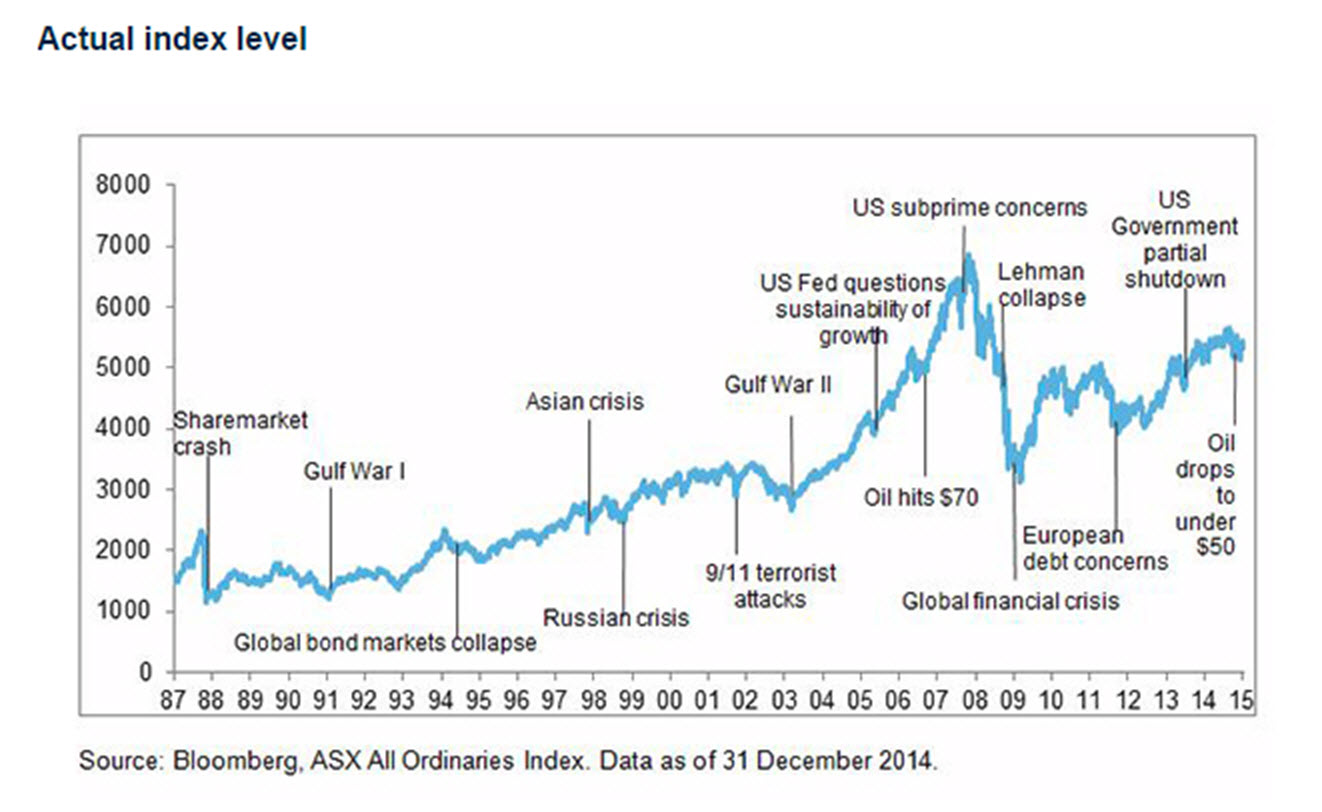
Share markets go up and down and this affects investor sentiment and the performance of listed companies which trade on the official stock exchange. The Global Financial Crisis (2008) had a major impact on the Australian share market but the market recovered. So it’s important to remember that markets always rebound from major events and move on to new highs, as the graph below shows.

Time is on your side

History tells us that investing in shares almost always provides a higher return than investing in low risk investments, such as cash or term deposits.

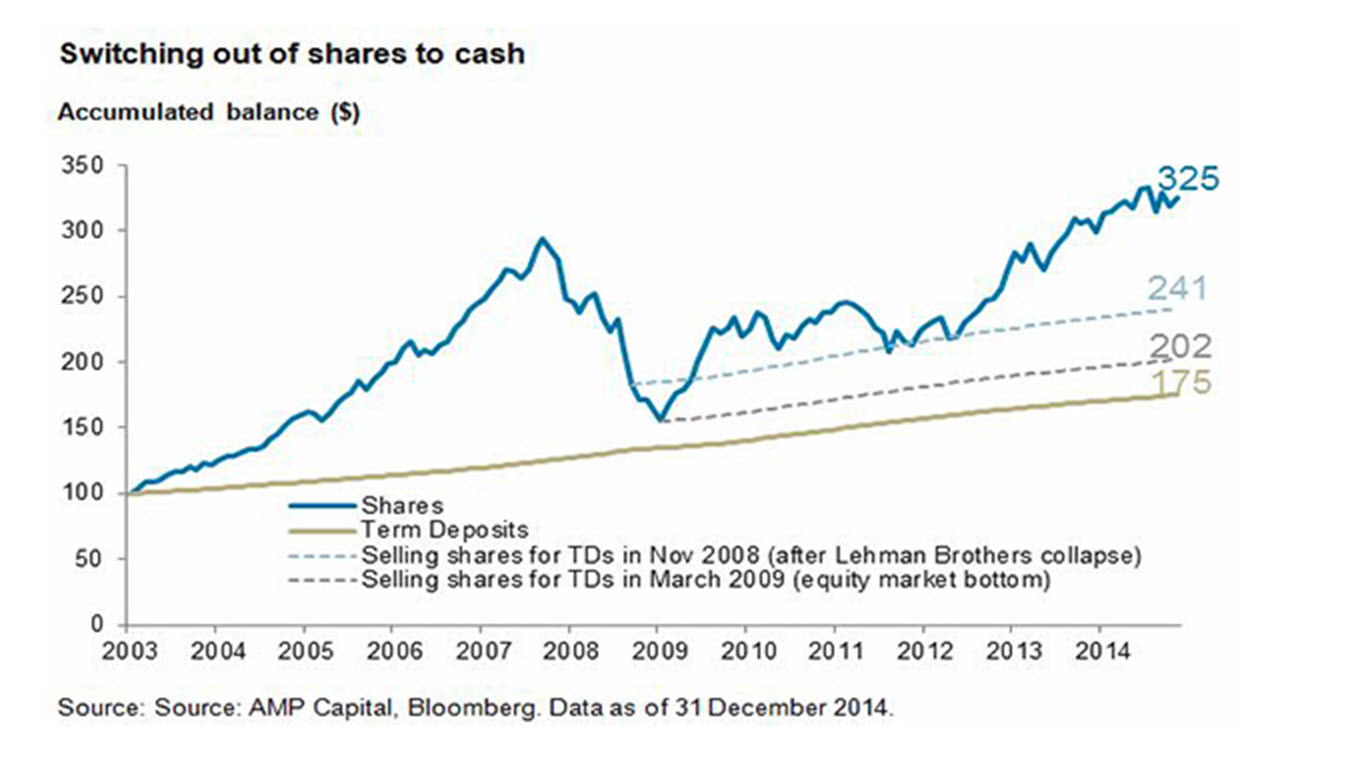
For example, if you’d had shares and switched out of them into cash during the Global Financial Crisis (GFC) in 2008, you’d still be recovering from their drop in value. But if you were an investor who ‘rode the storm’ and kept your money in shares, you’d be better off now, as you can see from the graph below.

We can’t predict the future

There’s no crystal ball to tell us when the markets are going to change and how they’re going to perform over time. That’s why, generally speaking, it’s best to have a variety of investments across different asset classes.

And remember to take a long-term view when it comes to investing.

Want to know more?

If you’d like to learn more, call us on (03) 9851 0300 so we can help you on your investing journey.

NINE RULES FOR INVESTORS TO KEEP IN MIND

Due to an obsession with Taylor Swift and then The Carpenters I decided I needed to have a Carpenters’ CD with the full Burt Bacharach medley they performed in the early 1970s. So I went to Amazon and found that it was only on a Japanese Carpenters’ Anthology CD which would set me back $US150 from the US or $65 for a “very good” second hand edition from Japan. The last time I got a “very good” second hand Elvis book from Amazon it had some pages missing but I decided to give the Japanese CD a go.

ATM SECURITY TIPS

ATM Tampering has become an increased method of Fraud. Here are some information and tips to follow when using ATMs.

What is ATM Card Skimming?

  • ATM card skimming is a method used by criminals to capture data from the magnetic stripe on the back of an ATM card. The data is then transmitted wirelessly to criminals waiting nearby.
  • The devices are attached over the top of an ATM’s card reader slot.
  • PIN capturing is attaching a camera in a certain position on the ATM in order to capture the user’s PIN.
  • ATM card skimming can also be done at EFTPOS terminals in shops. Staff can swipe your card through a fake terminal before the real one to capture your details.

How to identify an ATM skimming device

  • Pay attention to all of the touch and action points on the ATM. (i.e. keypad, card reader slot, lighting diffusers and ATM keypad area)
  • Inspect the front of the ATM for unusual or non-standard appearances around the card slot reader such as scratches, marks, adhesive and tape residue that could indicate that the ATM has been tampered with.
  • When shopping and paying via EFTPOS, keep an eye on your card at all times.

Examples of Tampered ATMs

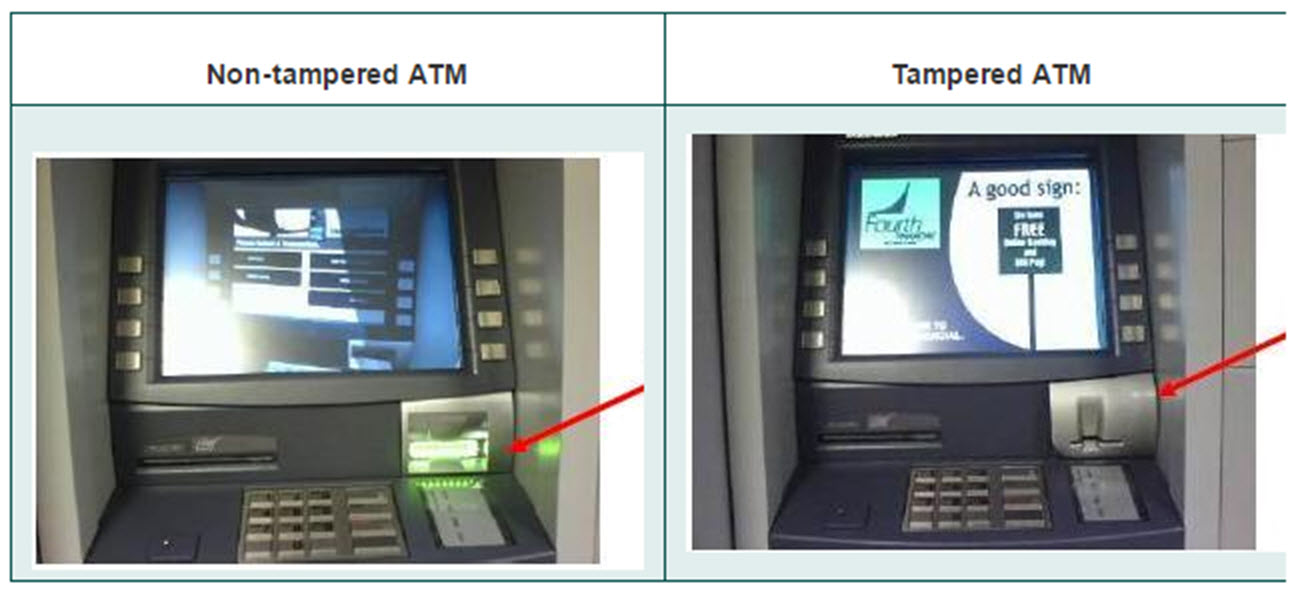
ATM skimming devices can often be very hard to detect. The below example shows a machine with and without a skimming device attached. Common things to spot are a non-flashing light on the card slot and sticky residue around the card slot.

ATM Security Tips

  • If you do not feel safe using an ATM or think that it has been tampered with, do not use it.
  • Be aware of your surroundings when using an ATM. Does not use or approach an ATM if there are people nearby that make you feel threatened. Be suspicious of an ATM if it has a physical sign on it advising you to use another ATM.
  • Do not approach any suspicious people hanging around the ATM under any circumstances.
  • Do not allow anyone to observe you entering your PIN into an ATM. You should cover the keypad with your hands whilst you enter your PIN, even if you believe you are not being watched.
  • If an ATM does not return your card or does not issue your money stay near the ATM and contact your bank immediately.

Article originally published by Suncorp Bank: http://www.suncorpbank.com.au/about/ways-to-bank/atms

PUTTING RECENT SHARE MARKET FALLS IN CONTEXT

Uncertainties regarding the emerging world and specifically China and the US Federal Reserve’s much talked about first interest rate hike have continued to result in volatile share markets over the last few weeks even though most have not made new lows for this downturn.

HOW SERIOUS IS THE THREAT FROM THE EMERGING WORLD?

Whenever there are sharp falls in share markets like recently, there is a temptation to wonder whether we are seeing a re-run of the last major crisis. Fortunately, the conditions today are very different to the run-up to the global financial crisis (GFC) which originated in the developed world, notably the US. The developed world hasn’t seen the sort of excesses that preceded the GFC: there has been no generalised bubble in investment spending (housing or otherwise), there has been no asset bubble, there has been no easing in lending standards like that which occurred with sub-prime debt and there has been no build up in inflation pressures or monetary tightening. So it’s hard to see the sort of unravelling in global financial markets that started in interbank lending and credit markets, threatening a seizing up of the global financial system and spreading through all growth assets that we saw through the GFC.