
The RBA holds rates at 3.6% and warns of rate hikes next year

By Dr Shane Oliver – Head of Investment Strategy and Economics and Chief Economist, AMP Capital | 10 Dec 2025

Key points

  • The RBA left its cash rate on hold at 3.6% as widely expected at is December meeting.
  • Its commentary also became more hawkish (ie leaning towards a rate hike) on the back of the further rise in inflation in October. Governor Bullock reiterated that the Board will be data dependent and effectively warned it may have to raise rates if inflation does not fall back.
  • We now expect the RBA to leave rates on hold next year with a fall back in inflation and still fragile consumer spending avoiding a rate hike but concerns about capacity constraints as the economy recovers likely preventing a rate cut and keeping the risk of a rate hike high.

RBA holds at 3.6% with a far more hawkish tone

2025 initially saw turmoil as US President Trump announced tariffs that were much higher than expected along with a bunch of other moves to upend US institutions and the global economic order. But the global economy held up okay. Key big picture themes for investors were:

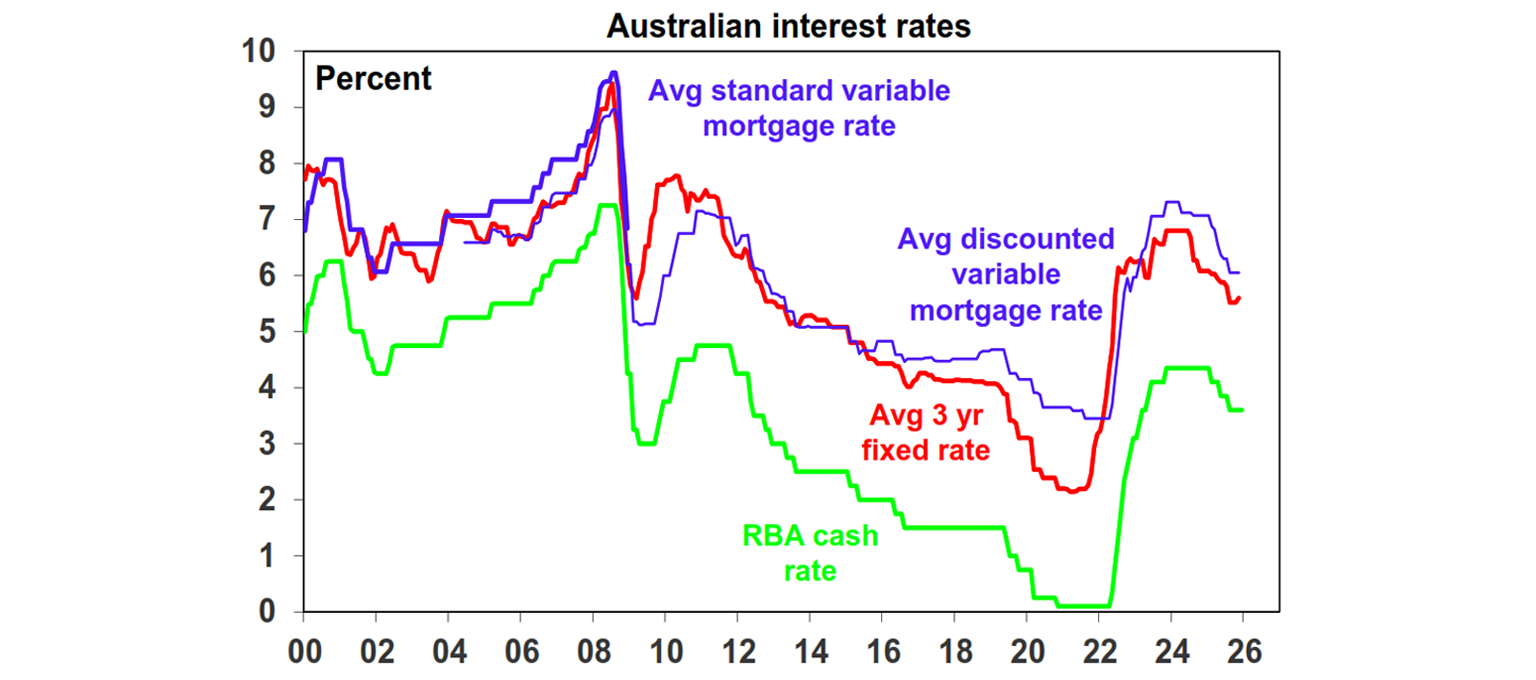
The RBA’s decision to leave rates on hold at 3.6% was no surprise with it being the consensus amongst all 29 economists surveyed by Bloomberg and the money market factoring in zero chance of a change. The decision leaves the RBA having only reversed three of the 13 rate hikes seen in 2022 and 2023 (not that a cut back to a 0.1% cash rate was expected) and mortgage rates around levels prevailing 13 years ago.
Source: Bloomberg, AMP

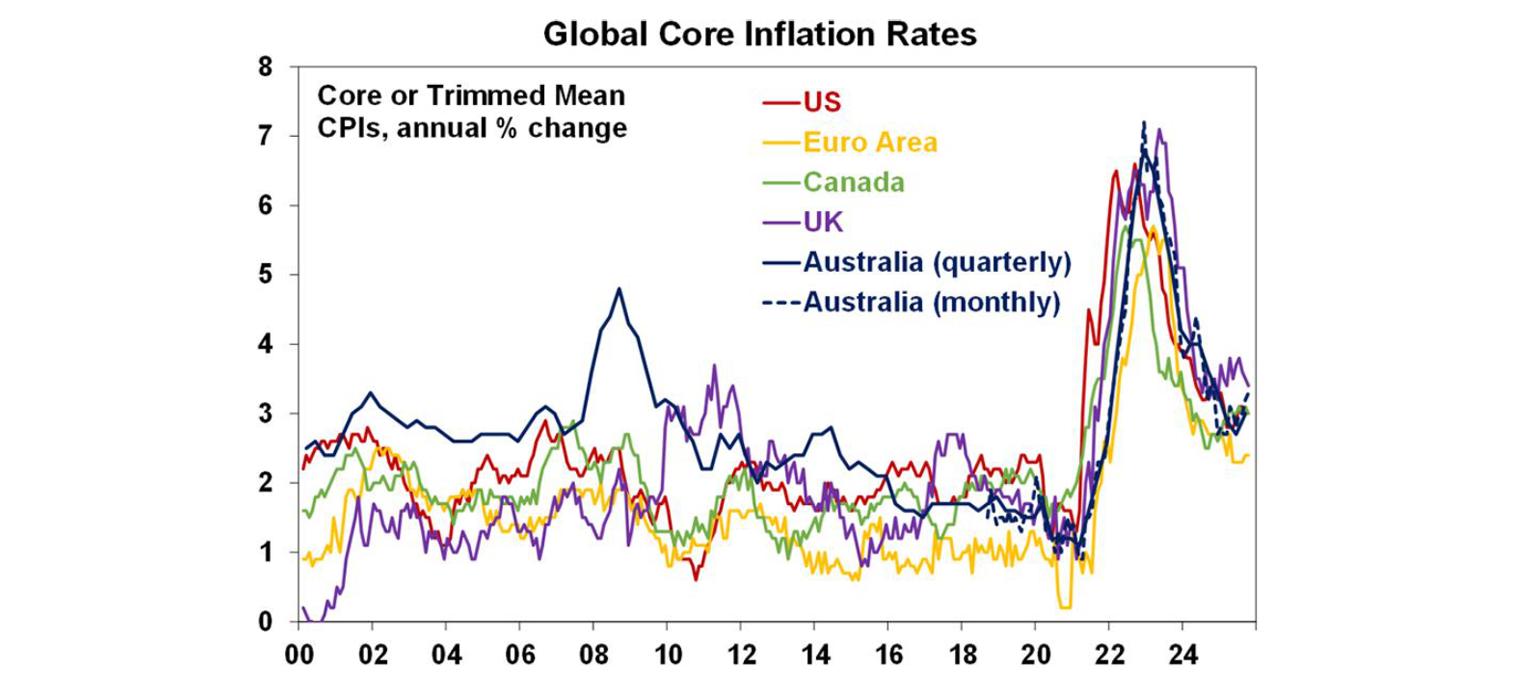
The RBAs on hold decision follows the further increase in inflation seen in the new October monthly CPI which occurred in both headline and trimmed mean (or underlying) inflation and has taken Australian inflation back above many comparable countries. See the next chart.
Source: Bloomberg, AMP

Given the recent run of hotter inflation and demand data it was also not surprising to see the RBA further ramp up its hawkish commentary, but it’s now explicit after Governor Bullock’s press conference that the RBA now has a tightening bias. To be sure, the RBA expressed caution about reading too much into the new monthly CPI showing a further rise in inflation and reiterated that it expects some of the rise in underlying inflation to be temporary.

But its commentary was progressively more hawkish compared to last month with the post meeting Statement noting that the rise in inflation may be becoming more broad based, growth is picking up including for private demand, the housing market is continuing to pick up, the labour market remains a little tight, surveys show capacity utilisation above its long-run average, growth in unit labour costs remains high and if the pickup in the private sector continues it will add to capacity pressures. All up the RBA concludes that “the risks to inflation have tilted to the upside”, whereas the language previously noted “uncertainty…in both directions”. And at the same time the RBA notes that the impact from global uncertainties has been minimal.

Governor Bullock’s press conference comments came across as even more hawkish than the post meeting Statement. In particular she noted that the RBA did not consider a cut but did consider circumstances that may drive a hike, it did not see cuts in the “foreseeable future” so its about a hold or hikes and she reiterated a recent warning that “if inflation pressures look to be more persistent then it..might have to consider whether we need to raise rates.” And further that “if it looks like inflation is not coming back to the band then the Board will have to take action and it will.”

This effectively leaves the door wide open for higher interest rates next year if needed.

The RBA also indicated it will remain data dependent and, on this front, December quarter CPI data to be released in late January ahead of the RBA’s next meeting in February will be key as to whether we see a rate hike early next year.

We expect the RBA to leave rates on hold in 2026, but the risks are now a bit more on the upside

We are now forecasting rates on hold through next year, amidst conflicting economic indicators.

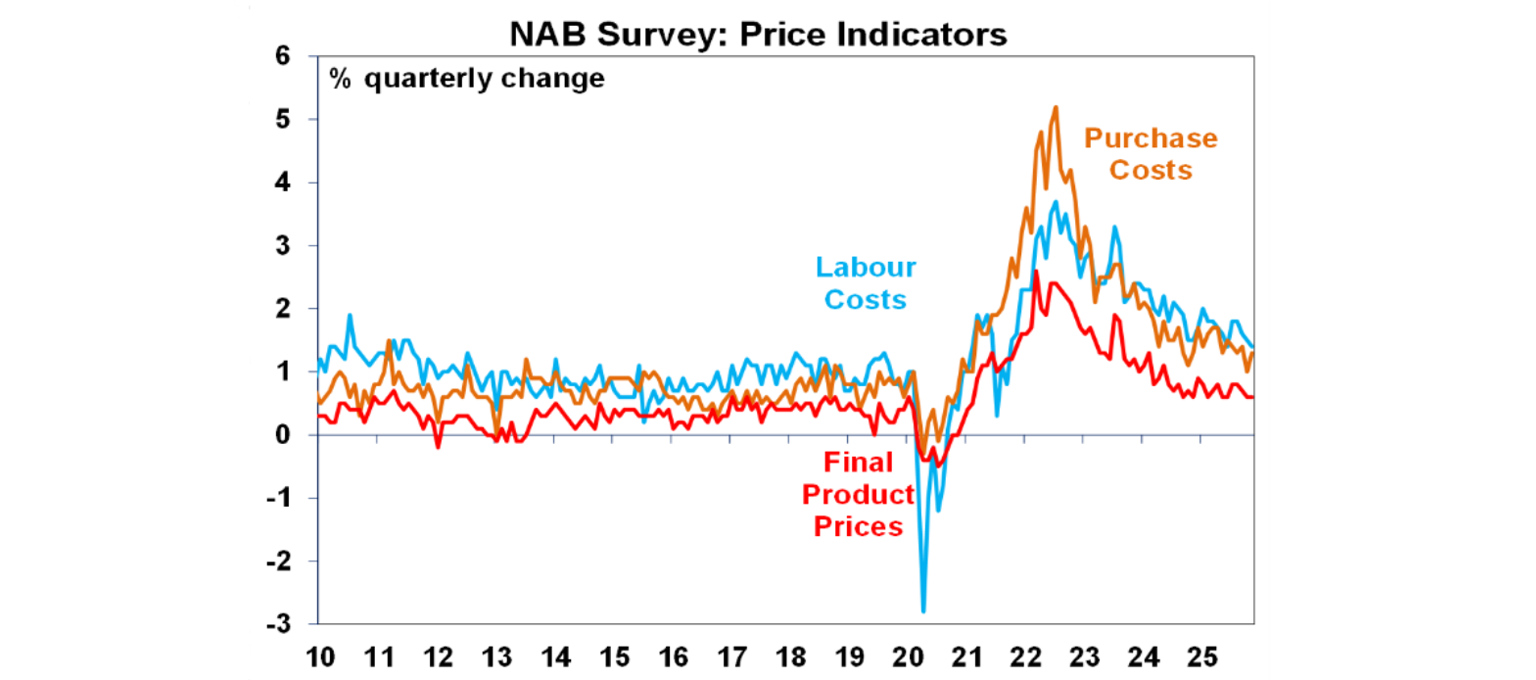
  • On the one hand, the rising trend in unemployment, falling job openings, the tendency for economic data to run hot and cold, uncertainty around the new monthly CPI and business surveys suggesting its pick up could be partly temporary (with final product price rises in the NAB survey remaining benign – see the next chart) and the fragile consumer recovery (with, eg, the NAB business survey reporting easing consumer sector orders) suggest that it’s too early to be considering rate hikes. And it’s arguable that potential economic growth at present is really now above 2%yoy given productivity growth of 0.8%yoy and labour force growth of 1.9%yoy, rather than at 2%yoy which is around the economy’s current growth rate.
Source: Bloomberg, AMP

  • But on the other hand, the strengthening trend in domestic demand growth and consumer spending, rising capacity utilisation in the NAB survey along with the renewed rise in inflation runs the risk that the economy is bumping into capacity constraints and possibly suggests that monetary policy is no longer restrictive. This would suggest that the risks are skewed to a rate hike next year.

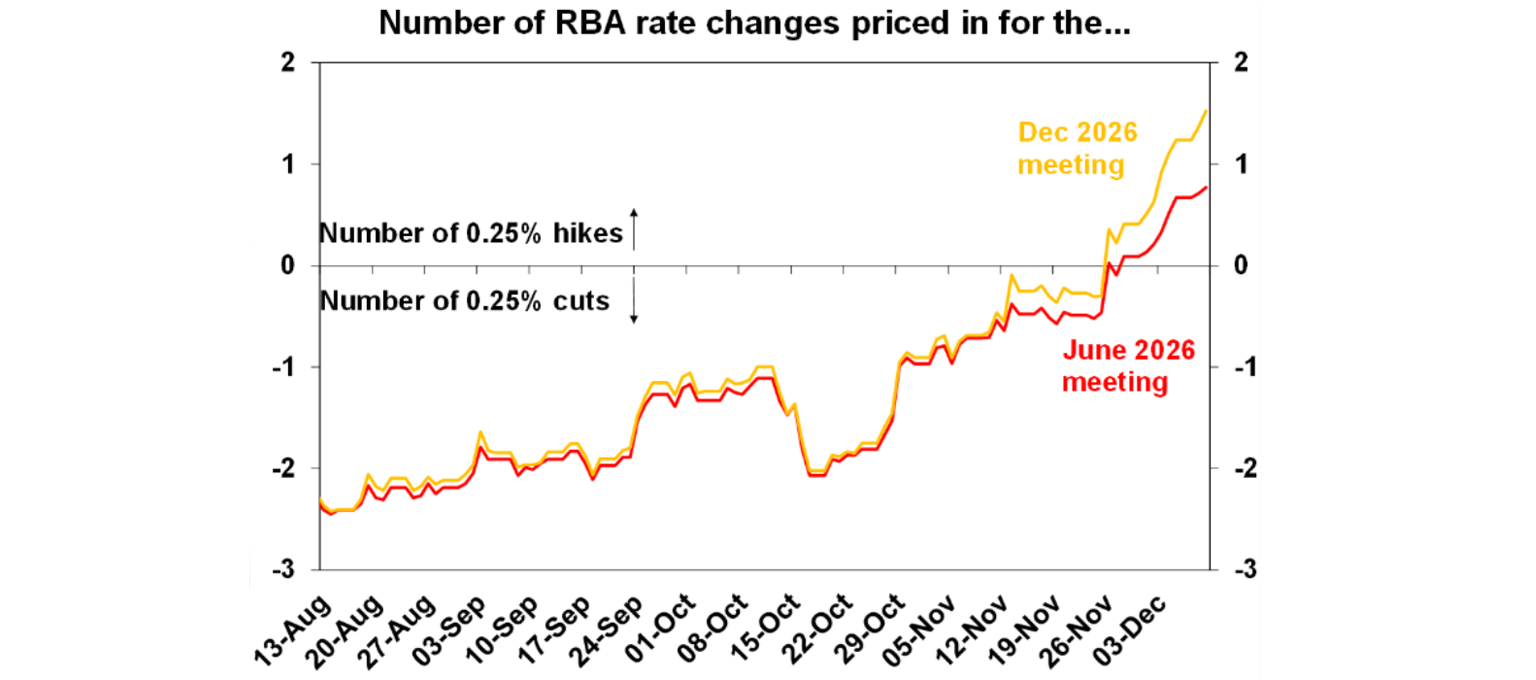
So, on balance we expect to see the cash rate remain at 3.6% in 2026, with the swing back to rate hikes more a story for 2027. But we concede that the risks look like they are now a bit more to the upside on rates in 2026. However, our assessment is that the swing in the money market from expecting 2 or 3 more cuts after the August RBA meeting to now expecting nearly two hikes next year is premature and a bit too extreme.
Source: Bloomberg, AMP

That said as noted above the key to what happens early next year will be the December quarter CPI to be released in late January, with the November CPI on 7th January providing some early indication. Our assessment is that underlying inflation will drop back a notch to 0.8%qoq or slightly less from 1%qoq in the September quarter – partly supported by the weaker trend in final product prices from business surveys – allowing the RBA to remain on hold at its February meeting. Of course, if trimmed mean inflation in the December quarter does not fall back as we expect (and comes in around 0.9%qoq or more) than a hike as early as February is possible. Note that the RBA’s implied forecast in its November Statement on Monetary Policy is 0.8%qoq.

The bottom line

While the RBA is rightly more hawkish in order to send a signal that it’s committed to getting inflation back to target and therefore to help keep inflation expectations “well anchored”, our base case is that rates will be left on hold next year at 3.6% as inflation falls back, albeit the risks are now skewing a bit to the upside. December quarter CPI inflation is the key to what happens early next year on rates.

It’s also worth noting that while rates bottoming at 3.6% is not good news for those with a mortgage it may not be such a bad thing to the extent that it reflects a more positive economic outlook as this will underpin a return to profit growth in Australia after three years of falling profits. Of course, it won’t be so good if inflation stays above 3%yoy.

And for those wondering – Governor Bullock noted that the RBA will look through the impact of the ending of the electricity rebates on inflation next year, just as they looked through their impact when they were applied.

Australian home prices up solidly – expect some slowing in 2026

By Dr Shane Oliver – Head of Investment Strategy and Economics and Chief Economist, AMP Capital | 1 Dec 2025

Key points

  • Cotality data shows national average home prices rose strongly again in November, but with the pace of growth slowing slightly to 1%mom.
  • Near record low vacancy rates is contributing to a pickup in annual rental growth to 5%yoy.
  • The lagged impact of rate cuts, the expansion of the 5% low deposit scheme and the startup of the Help to Buy scheme along with the ongoing housing shortage are expected to drive further gains in home prices next year.
  • However, the gains are likely to slow in 2026 as a result of poor affordability, the less favourable outlook for interest rates with the risk of a rate hike and APRA moving to ramp up macro prudential controls and likely to do more.
  • After around 8.5% growth this year we now expect property price growth to slow to around 5-7% in 2026.

Introduction

National average property prices rose solidly again in November with this year’s rate cuts boosting demand along with the expanded 5% first home buyer deposit scheme. All capital cities saw prices rise.

Australian dwelling price growth

Source: Cotality

However, the national pace of gains slowed slightly from 1.1%mom in October to 1% in November. And a divergence has opened up again with the boom time cities of Perth, Brisbane and Adelaide accelerating in recent months and Sydney and Melbourne slowing a bit. Poor affordability is likely biting in Sydney along with less negative listings and stronger supply and the malaise around Victoria is likely impacting Melbourne.

Source: Cotality, AMP

The run of strong monthly price gains has taken annual growth to 7.5%yoy which is back above its decade average of 5.4%pa.

What drove strong home price growth this year?

The surge in property prices this year has been stronger than the 3% rise we expected at the start of the year and reflects a combination of three RBA rate cuts, the expanded first home buyer 5% deposit scheme which was only announced prior to the Federal election, improved consumer confidence and the ongoing shortage of housing. This has also been helped by below average levels of listings as vendors hold back for higher prices and as lower interest rates are relieving the pressure to sell for some distressed mortgage holders. These considerations have clearly more than offset the impact of poor affordability.

  • Historically rate cuts have been associated with an upswing in property prices unless there has been a recession and sharply rising unemployment. And this year has been no exception with prices starting to rise from February when the RBA started cutting rates. Rate cuts boost how much buyers can borrow and hence pay for a property. Roughly speaking, each 0.25% cut in variable mortgage rates adds around $11,000 to how much a buyer on average earnings can borrow. And of course this has been more than swamped by a rise in median home prices of around $90,000 since January.
  • The Federal Government promised prior to the May election that it would expand access to the low deposit guarantee allowing most FHBs to get in with a 5% deposit from 1st October, which had been brought forward from 1st January 2026. And the Government’s Help to Buy Scheme will start this week with 10,000 places a year which will see the Government take a 30% to 40% equity stake in the purchase price of a property for an owner occupier. Both of these demand side policies add to demand by bringing forward purchases and adding to how much a buyer can pay.
  • While some slowing in population growth and improving housing completions are bringing the property market into better balance on annual basis, there is still an accumulated housing shortfall that has built up over the last few years of under building. We estimate this to be around 200,000 to 300,000 dwellings.

The upswing in property prices in Sydney and Melbourne this year is consistent with an upswing in auction clearance rates in both cities this year. These have since cooled from their August high which mainly looks seasonal but could be a sign of things to come as affordability bites.

Expect prices to continue rising but at a slower pace

Which brings us to the outlook for 2026. The combination of the lagged effect of this year’s rate cuts, the expanded first home buyer 5% deposit scheme and now the Help to Buy scheme, improved consumer confidence and the ongoing shortage of housing are likely to keep the upswing in property prices going in 2026. However, the pace of gains is likely to slow from that seen this year as the RBA now looks to be at or very close the bottom of the interest rate cycle with talk that the next move in rates will be up, APRA is starting to ramp up controls to slow risky or speculative lending and affordability is now worse than ever.

  • On the interest rate outlook we think another RBA rate cut next year is still possible, but it will require a run of softer inflation numbers back below target and higher unemployment. And given the early stage of the economic recovery it’s arguably too early to expect the RBA to raise rates next year. That’s more likely a 2027 story. However, given the recent run of data showing rising inflation, still low unemployment and possibly strengthening private sector economic growth, we are not particularly confident and chatter that rates may have bottomed with a possible rate hike later next year may act as a dampener on buyer demand. Either way this will leave mortgage rates at their cycle low well above their record lows seen in 2021 of around 2 to 3%. As such, the buying capacity of home buyers is expected to remain below the levels seen in 2021-22. This will limit the upside in property prices.
  • APRA is now starting to ramp up regulatory controls to cool riskier forms of property lending. The initial move to cap the proportion of each bank’s housing lending that goes to borrowers with a debt-to-income ratio of six times or more at 20% from 1st February is likely to impact investors (who tend to have higher DTI ratios) more than owner occupiers but could impact some first home buyers seeking to take advantage of the 5% deposit scheme. It won’t have much impact initially (except maybe for small lenders) as the aggregate ratio is well below the 20% cap at present, but it’s clearly a pre-emptive move designed to cool investor activity before it gets too hot.
  • If it doesn’t work (and some borrowers may try to get in ahead of the cap becoming binding, so it could boost investor lending in the near term) APRA is likely to do more like putting a cap on investor credit growth like the 10%yoy cap it applied in late 2014. On this front, note investor lending is already running at a pace in excess of 10% which suggests a high risk that APRA will do more to slow down riskier forms of home lending that it fears may create financial stability risks.

Source: RBA, AMP

  • And housing affordability is deteriorating from already very poor levels. This is evident in the ratio of home prices to wages and incomes being at record levels. This could limit the upside in property prices – although we and many others have been saying that for years and home borrowers appear to be able to devote an ever-rising proportion of their income to debt servicing – albeit with the help of BOMAD (the bank of mum and dad) and governments.

Source: Cotality, ABS, AMP

  • Finally, slower population growth, reflecting a crackdown on student visas and a return to the normal pattern of students leaving after they complete their degrees, may also take some pressure off the home buyer market. Population growth has already slowed from a peak of 662,000 over the year to September 2023 to 423,000 over the year to March with the Government’s immigration forecasts implying a fall to around 365,000 in 2025-26.

Overall, Australian home prices are likely to remain in an upswing in 2026 on the back of the lagged impact of lower interest rates, more support for first home buyers and the housing shortage. However, it’s likely to be constrained by less rate cuts than previously expected with the risk of a rate hike, APRA’s move to ramp up macro prudential controls with more likely to come and poor affordability. After 8.5% or so growth this year we anticipate some slowing in national average home price growth to around 5-7%yoy next year.

With FOMO running hot in the boom time cities of Brisbane, Perth and Adelaide they are likely to remain the strongest over the next six months. But as their relative affordability continues to deteriorate with home price to income ratios in each city now being well above that in Melbourne some sort of rotation back to the laggards including Melbourne and possibly Sydney is likely at some point later next year. The other laggards of Hobart, Darwin and Canberra already appear to be picking up pace.

What to watch?

The key things to watch will be interest rates, unemployment and population growth. For example, a return to rate hikes, a sharply rising trend in unemployment and a sharp slowing in net migration could result in a resumption of property price falls. On the flipside a faster fall in rates and faster than expected population growth could drive a stronger upswing in property prices.