RBA starts the year off with a rate hike

By Dr Shane Oliver – Head of Investment Strategy and Economics and Chief Economist, AMP Capital | 3 Feb 2026

Key points

  • The RBA hiked its cash rate by 0.25% to 3.85% as widely expected in response to inflation running above target.
  • Its commentary was cautious and hawkish with inflation now expected to stay above target for longer even with assumptions for two more rate hikes and the stronger $A.
  • We thought it was a close call and leaned to a hold. But having hiked we expect the RBA to hold for the remainder of the year as we see underlying inflation as having peaked in the September quarter and falling back to target.
  • Valid concerns about capacity constraints though are likely to keep the risk of a further rate hike high.
  • The best thing government can do to help alleviate this is to lower the level of public spending.

Introduction

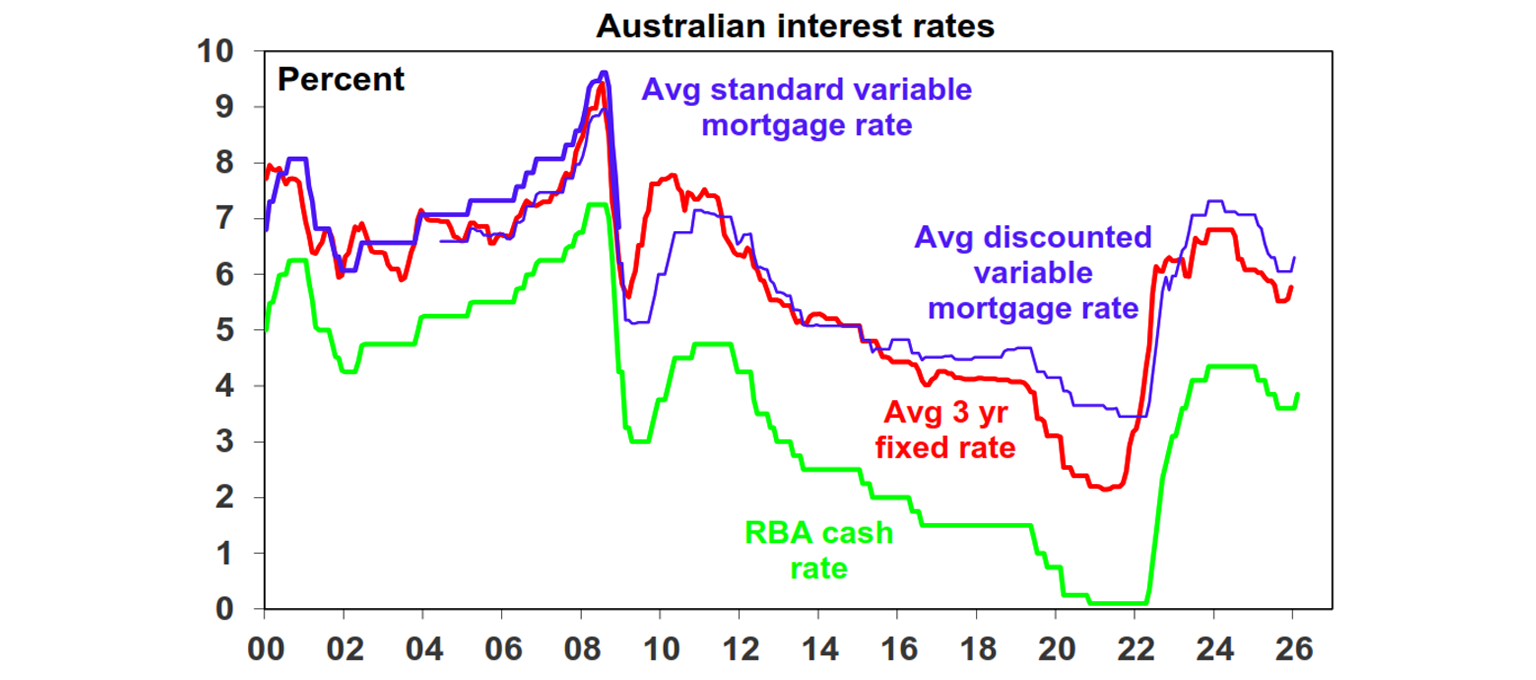
The RBA’s decision to hike rates to 3.85% was no surprise with it being about 70% factored in by the money market and 22 of the 28 economists surveyed by Bloomberg expecting a hike. We thought that the RBA should and (wrongly as it turned) thought it would hold but we also saw it as a very close call. The decision means that the RBA has already reversed one of the only three rate cuts we saw last year, which of course followed 13 rate hikes seen in 2022 and 2023. Once passed on to mortgage holders it will leave mortgage rates around levels prevailing 13 years ago. Of course, it should also mean a slight rise in bank deposit rates.

Source: Bloomberg, AMP

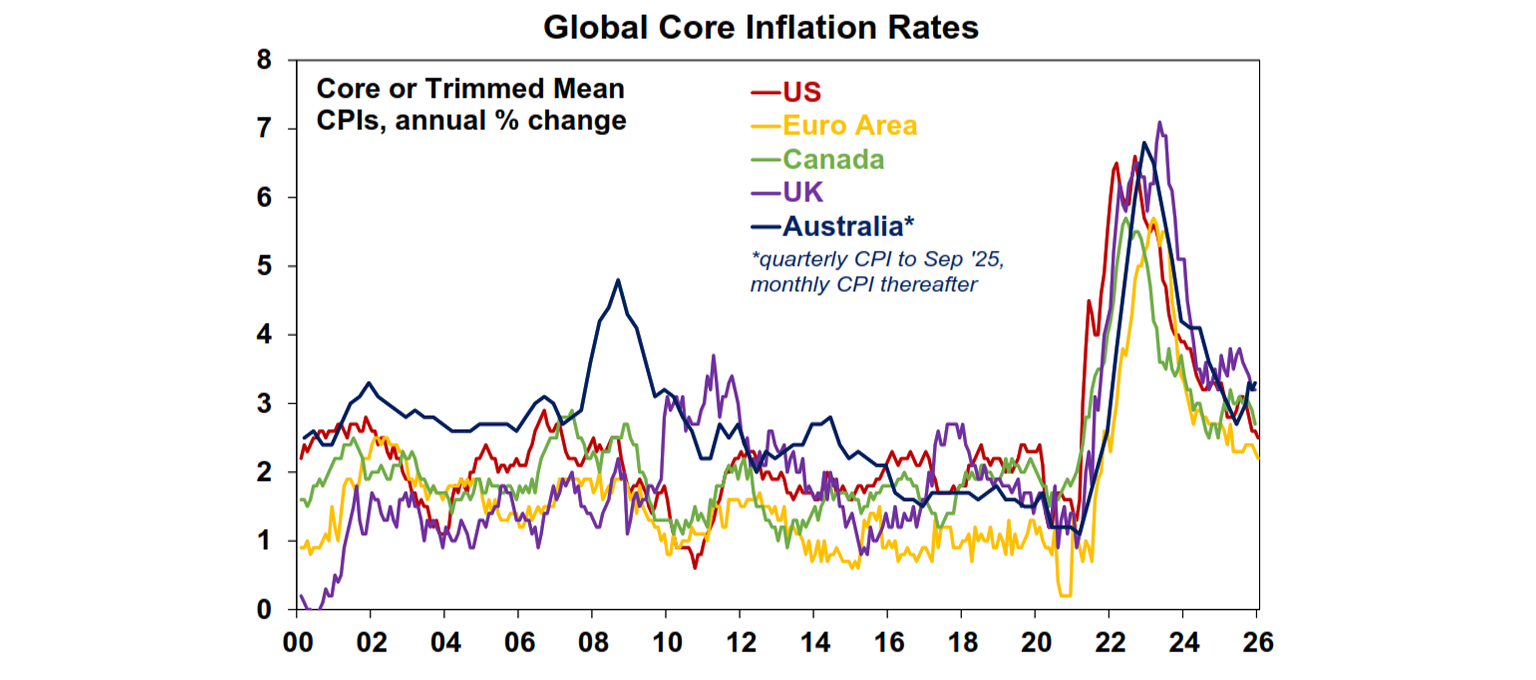
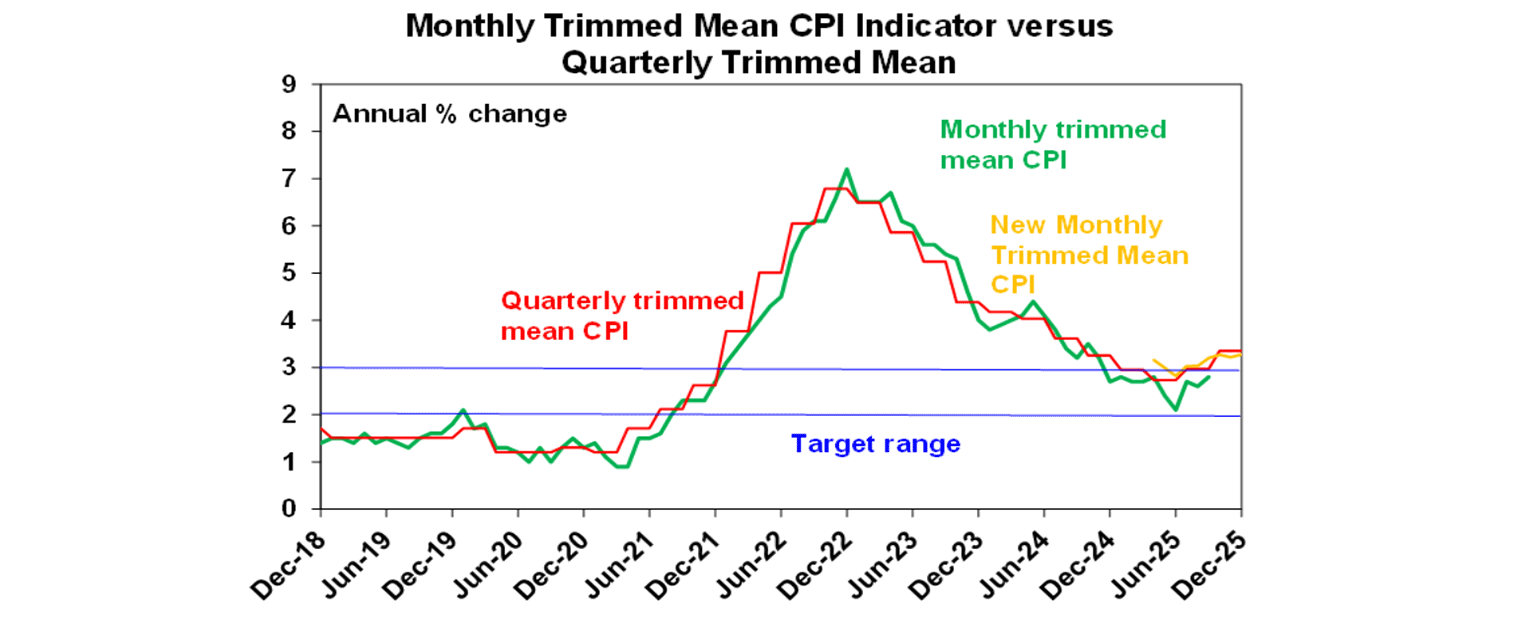
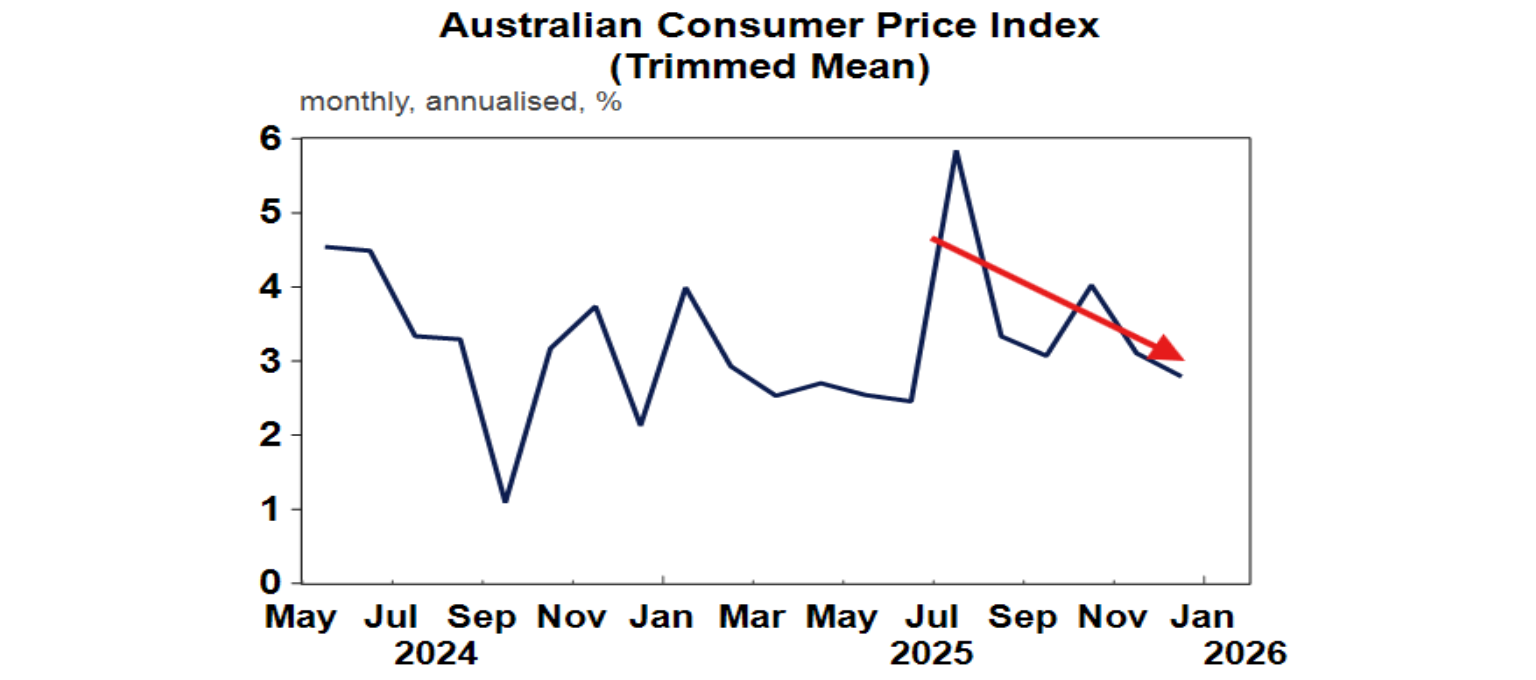
The decision to hike largely reflected the increase in annual inflation through the second half last year with quarterly trimmed mean (or underlying) inflation rising to 3.4%yoy and monthly trimmed mean inflation at 3.3%yoy, which is well above the 2-3% inflation target and was above the RBA’s forecast for 3.2%yoy. This has led the RBA to conclude that the economy has less spare capacity than it previously thought.

Governor Bullock’s press conference comments basically reinforced these concerns and indicated caution regarding the outlook leaving the door wide open for further interest rate hikes if needed.

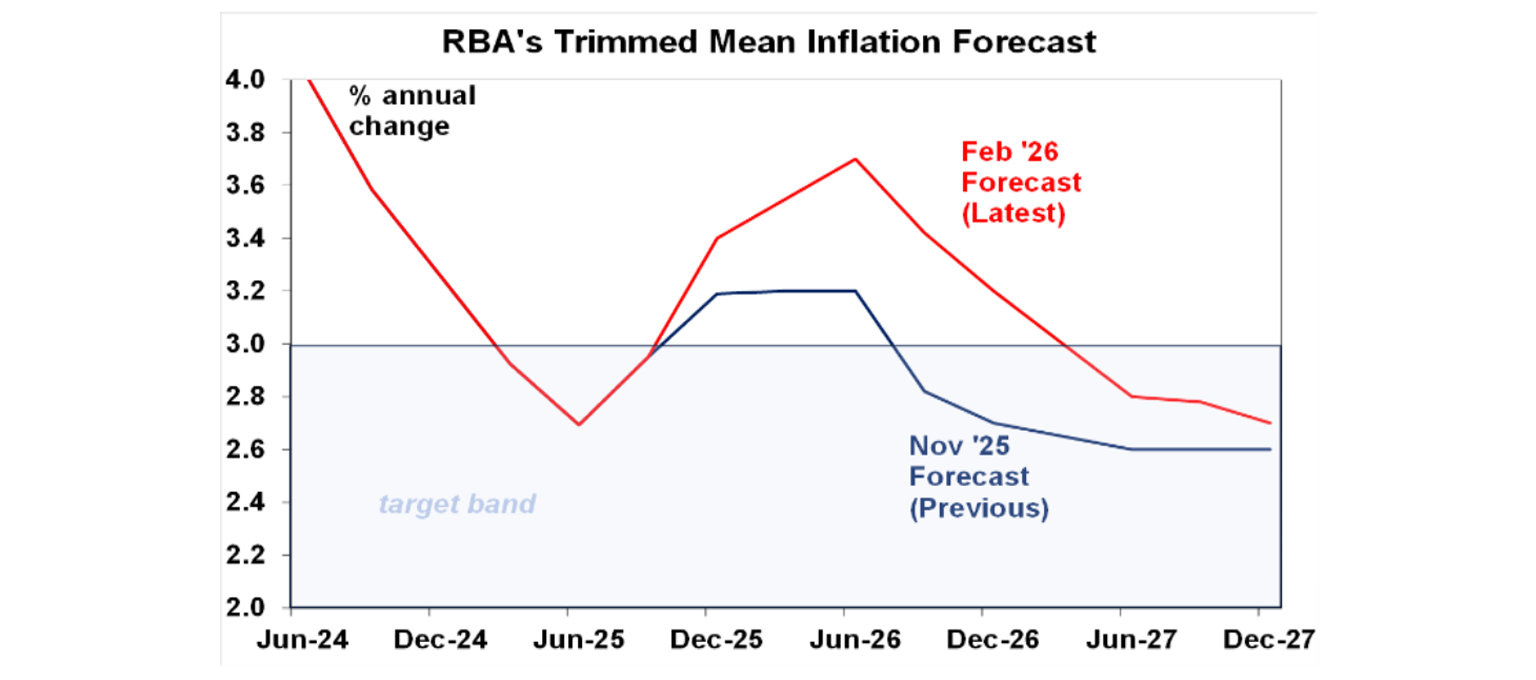
Consistent with its decision to hike the RBA now sees inflation staying above target for longer, despite assuming a higher $A and two more rate hikes the RBA now sees underlying inflation staying higher for longer and not really getting back to the midpoint of the inflation target until June 2028. This reflects its revised assessment that the economy has more capacity pressures than previously assessed – compared to say back in August last year when it saw inflation around target even with two or three more cuts! Of course, as the lagged impact of the forecast growth slowdown flows through inflation could conceivably fall below target in 2028-29 but that’s a long way off.

Source: RBA, AMP

We expect the RBA to leave rates on hold

There is an old saying that rate hikes are like cockroaches – if you see one there is likely to be another! However, we lean a bit more optimistic and expect this to be a case of one and done:

  • Monthly trimmed mean inflation has progressively trended lower from 0.47%mom in July to 0.23%mom in December and slowed from 1%qoq in the September quarter to 0.9%qoq in the December quarter.

Source: Macrobond, AMP

  • We still expect underlying inflation to fall back to target this year.
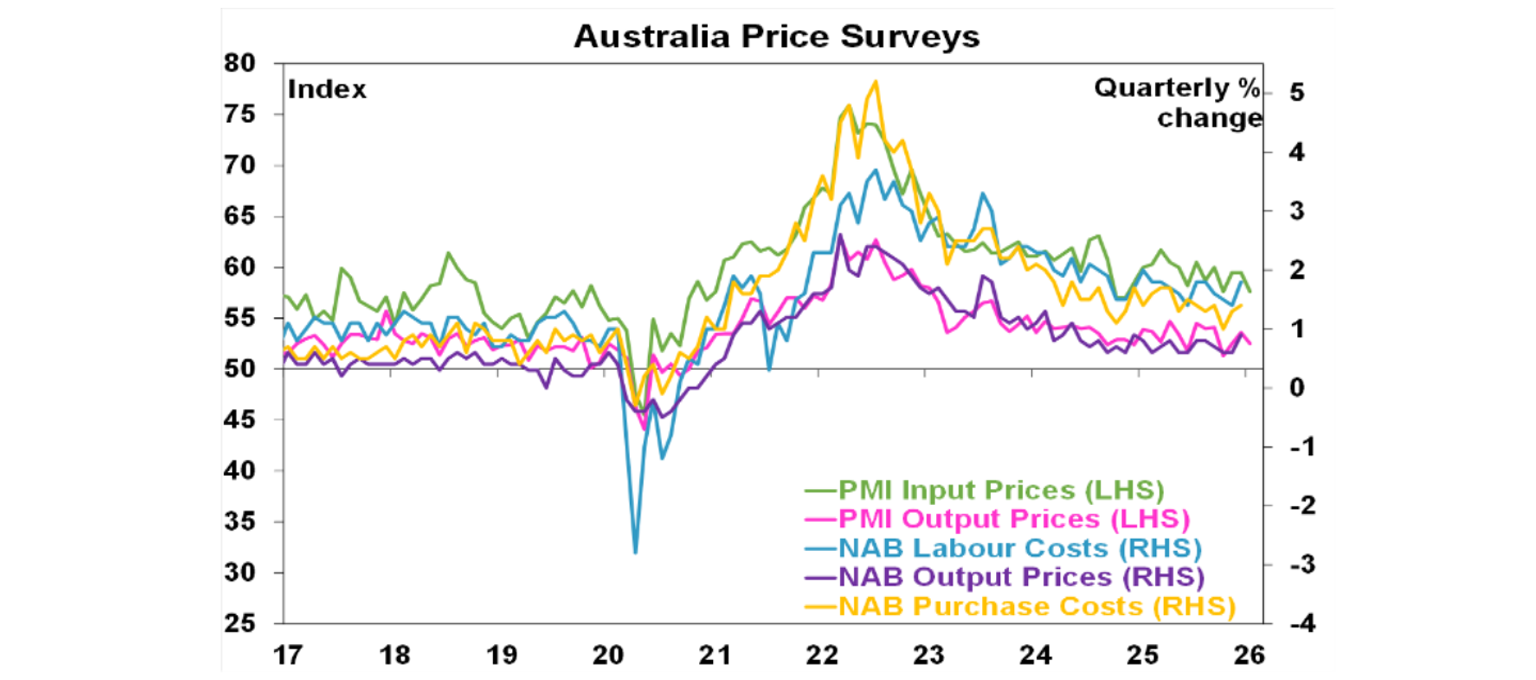
  • Business surveys show output price indicators around levels consistent with the inflation target – see the pink & purple lines in the next chart.

Source: NAB, Bloomberg, AMP

  • Consumer spending is likely to take a hit as we have swung quickly from rate cuts to hikes as mortgage stress likely remains high. For mortgage holders – who are far more responsive in their spending decisions to changes in their disposable income than outright homeowners – the RBA’s 0.25% hike will mean that their interest payments will start going back up again. For someone with a $660,000 average new mortgage this will mean roughly an extra $110 in interest payments a month or an extra $1300 a year. This will likely dent spending, particularly as expectations will now be for more hikes. Sure those relying on bank deposits will be better off but household debt in Australia is almost double the value of household bank deposits.
  • The rise in the Australian dollar is a defacto monetary tightening that will help lower imported inflation.

That said, the risks are still skewed on the upside for the cash rate if domestic demand growth continues to strengthen adding to concerns about the economy bumping into capacity constraints and if inflation does not fall as we expect. On balance we expect to see the cash rate remain at 3.85% for the remainder of the year, and we see money market expectations for two more rate hikes as being a bit too much.

The key to watch for what happens next year will be the monthly inflation data. Another move in March seems unlikely given that the RBA has just moved but March quarter CPI data to be released in late April, ahead of the RBA’s May meeting will likely be key. If it shows a further cooling in trimmed mean inflation as we expect then the RBA will likely hold.

How can government take pressure off inflation?

Whether it was a hold or a hike, inflation has proven more sticky than expected a year ago. Pressure to deal with this has largely fallen on the RBA but Australian governments could make life a lot easier for it. Government is contributing to the strength in inflation in Australia in two ways. First, prices for items administered by government or indexed are rising around 6%yoy, well above the 2.9%yoy price rises for items in the market sector of the economy. So governments should be looking for ways to lower this.

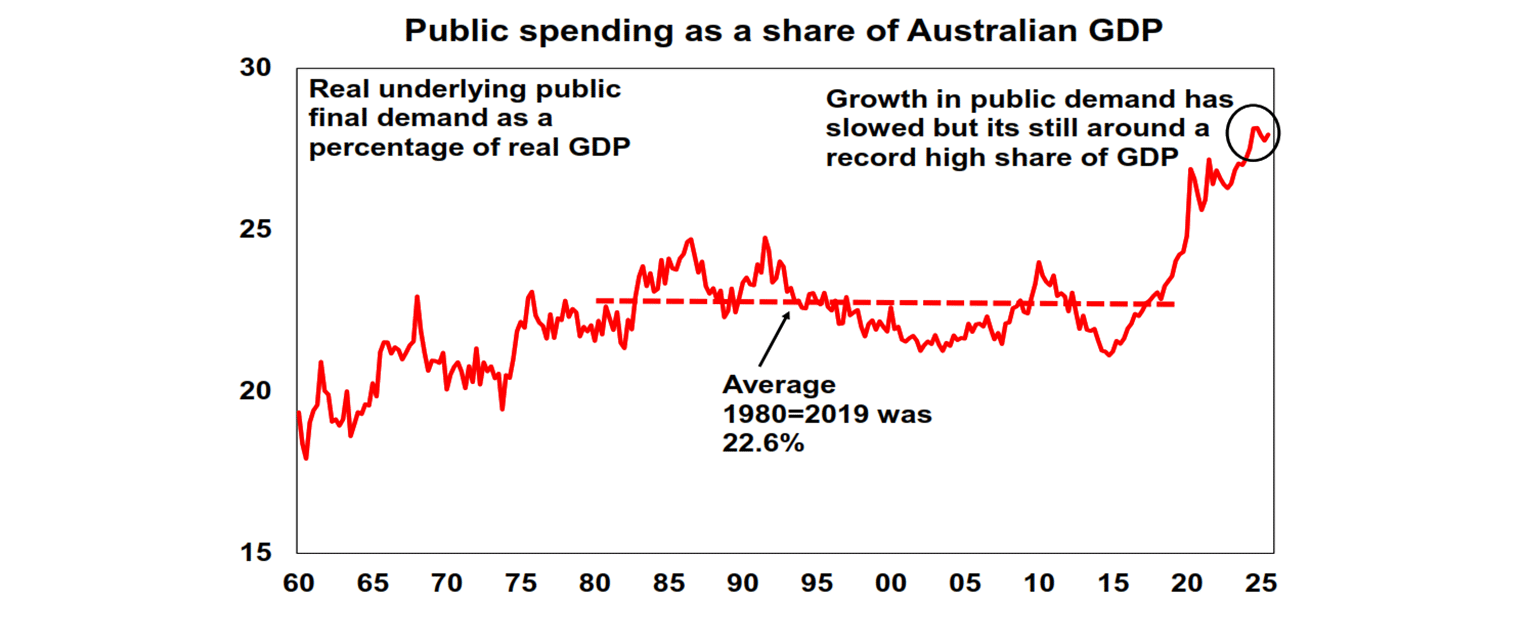
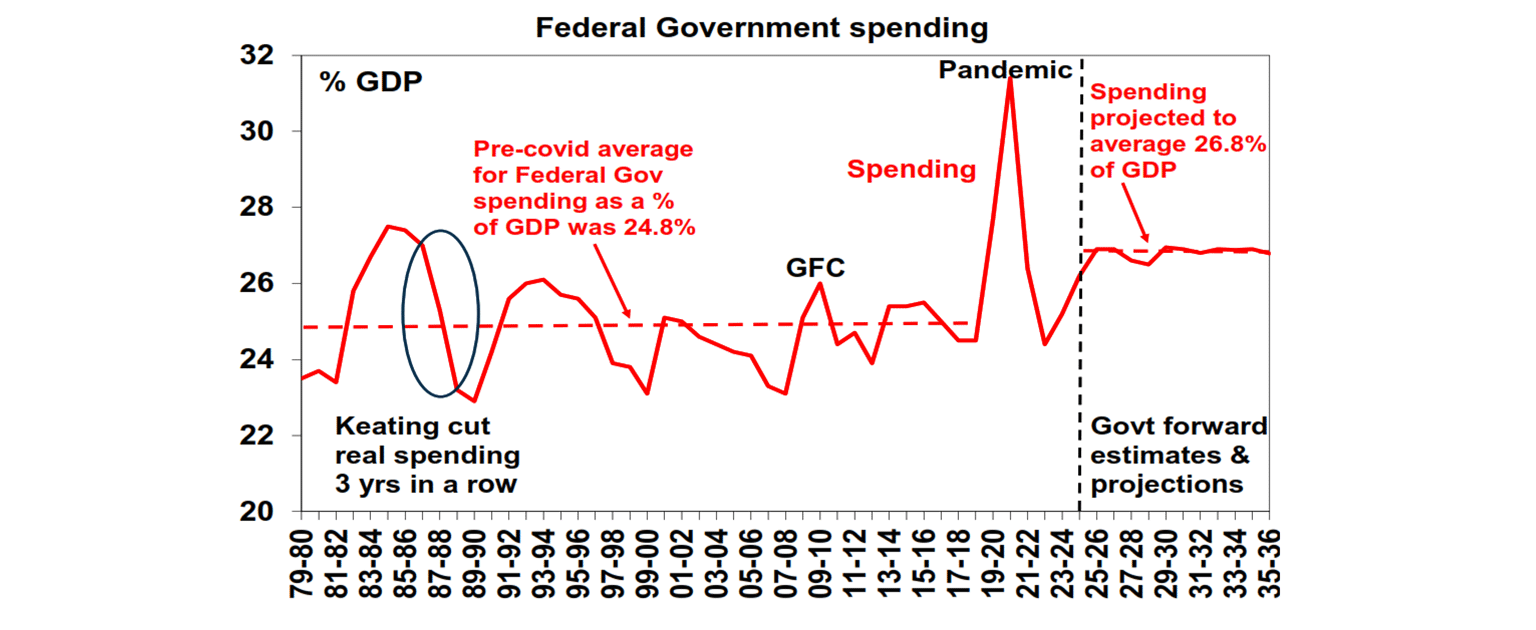
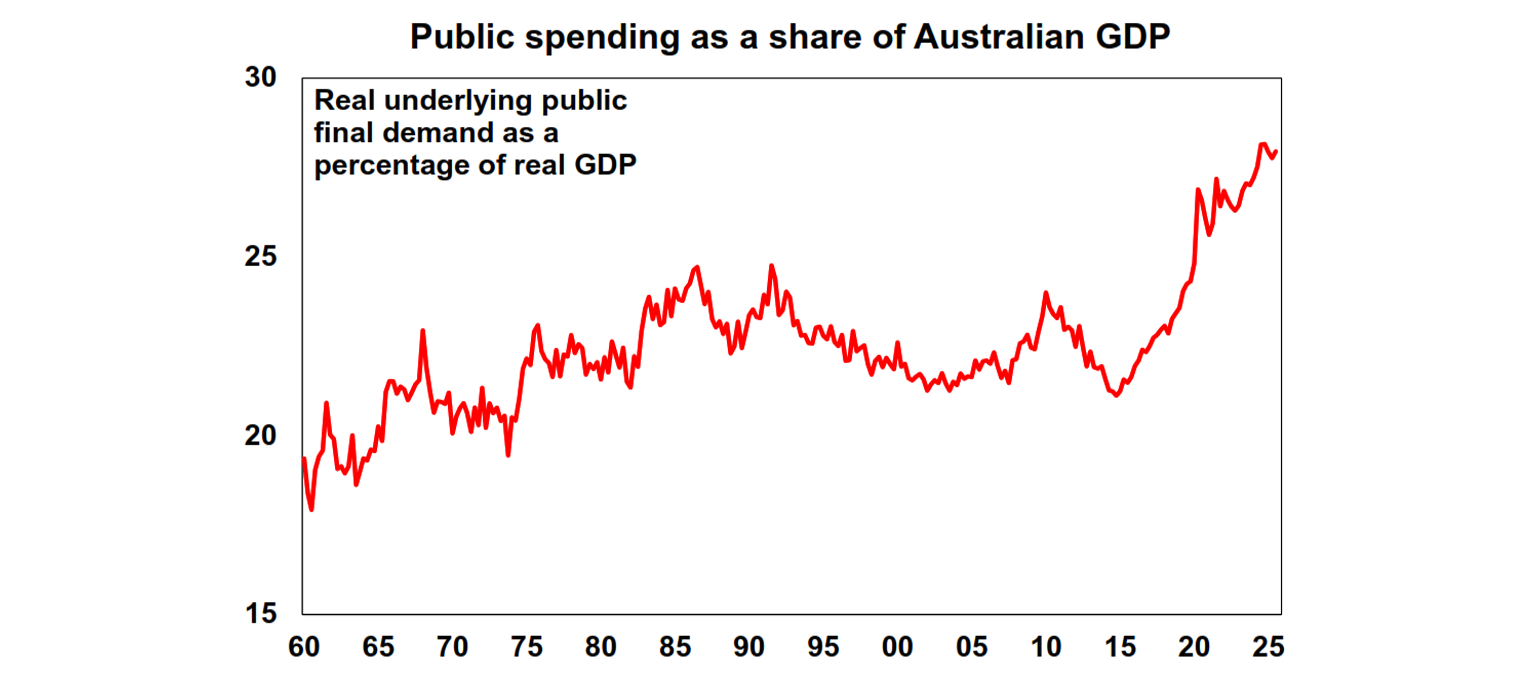
Second, and more fundamentally while public spending growth slowed to around 1.4%yoy in the September quarter, that followed many years of 4% plus growth which left public spending around a record 28% of GDP. As Governor Bullock noted, aggregate demand includes public and private spending. So high levels of public spending as a share of the economy are constraining the recovery in private spending that can occur without seeing the economy bump up against capacity constraints, which flows through to higher prices. So, the best thing that Australian governments can do to help bring down inflation would be to cut government spending back to more normal levels which would free up space for private sector growth without higher inflation. Lower public spending will also help boost productivity by freeing up resources for the more productive private sector which should help lower inflation longer term.

Source: ABS, AMP

The bottom line on rates

While the return to rate hikes on the back of inflation running above target is disappointing, I can understand the RBA’s desire to get back on top of it and avoid perceptions that its tolerant of high inflation. As they say “a stitch in time saves nine.” Looking forward we are confident that underlying inflation will continue to fall back to target and so see the RBA remaining on hold for the remainder of the year, even though the risks are on the upside. The best thing Federal and state governments can do is to quickly reduce the level of public spending to free up more space for private sector spending.

Implications for the economy and financial markets

For the economy the implications from the RBA’s rate hike with talk of more to come are as follows:

  • Somewhat weaker economic growth from later this year.
  • A bigger slowdown in home price growth – we were assuming home price growth this year of 5-7% but with rate hikes its possible we now see falls. Sure home prices rose in 2023 despite rate hikes but that was because immigration surged. Roughly speaking each 0.25% rise in mortgage rates knocks about $10,000 off how much a person on average earnings can borrow to buy (and hence pay for) a home.
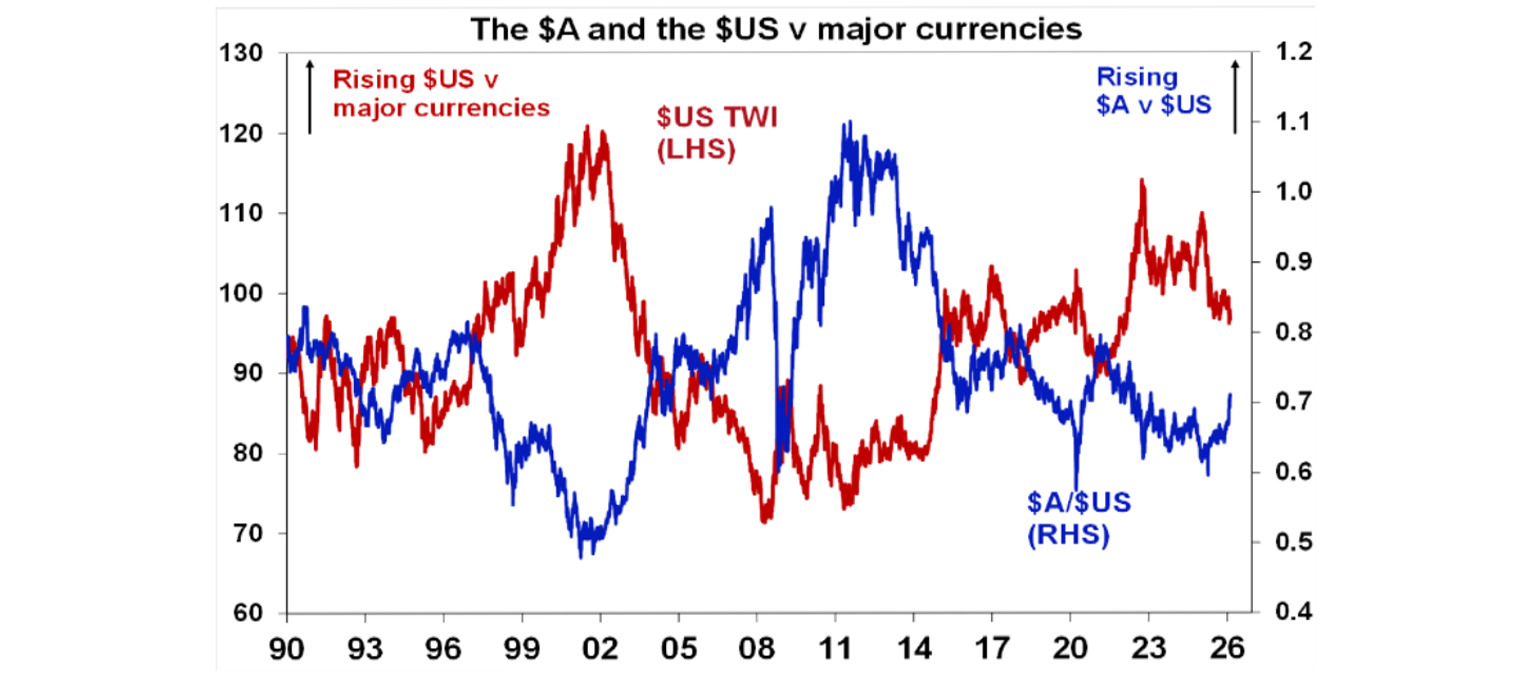
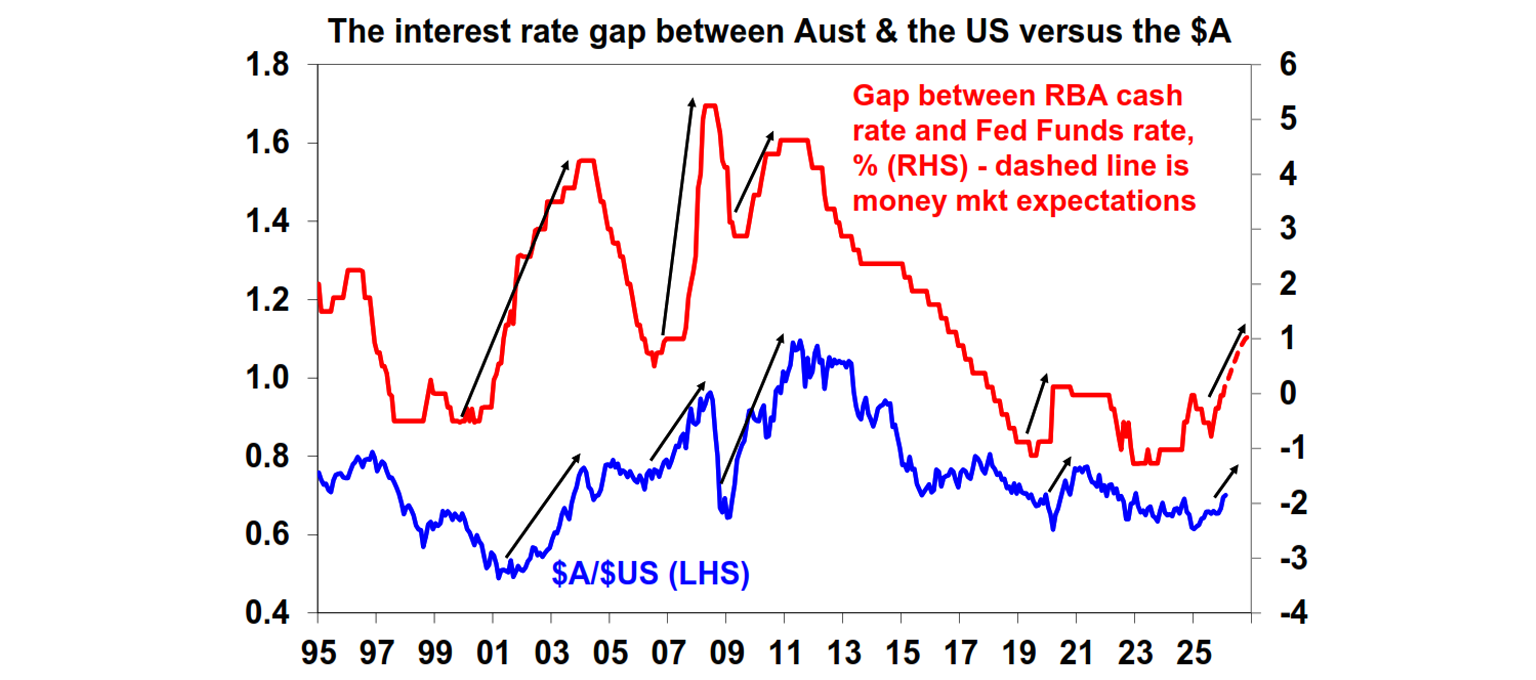
  • The $A is likely to continue to rise as the gap between Australian and US interest rates widens further.

Source: Bloomberg, AMP

  • All up this could have a dampening impact on the Australian share market’s relative performance this year although I still expect it to have a reasonable year as profits rise after three years of falls.

From the age of the economist to the age of the populist – key insights from economics, why many are ignored & what it means for investors

By Dr Shane Oliver – Head of Investment Strategy and Economics and Chief Economist, AMP Capital | 27 Jan 2026

Key points

  • Economics provides a range of insights including that: there is no free lunch; prices in free markets are usually best at allocating scarce resources; government policy comes with benefits and costs; productivity underpins living standards; and inflation is mostly a monetary phenomenon.
  • Unfortunately, these are increasingly being ignored with the rise of populist politicians with simplistic short term policies.
  • Over the long term this risks a less favourable economic environment – less growth, more inflation and more volatility which could weigh on investment markets.

Introduction

While a casual observation of economists would suggest they are invariably at logger heads this partly reflects the tendency of the media to juxtapose economists with contrasting views on issues like where interest rates, inflation or unemployment are heading. On top of this economists are trained to see all sides of an issue & so are more likely to see things as shades of grey rather than black and white – which is good but many love black and white! As Winston Churchill is said to have said “if you put two economists in a room, you get two opinions…” Or “if you laid all the economists in the world end to end, they’d never reach a conclusion” as often attributed to George Bernard Shaw. But at a fundamental level the economics profession tends to agree on a lot. This note looks at key insights from economics, their relevance today & why they are increasingly ignored.

Ten key economic insights

Note I used AI, and specifically ChatGPT, to help compile this list!

1. There is no free lunch – the basic economic problem is that human wants are unlimited, but resources are scarce. So we have to learn how to best allocate scarce resources. This means recognising that getting more of something may mean getting less of something else.
2. Prices guide decisions – prices signal peoples’ preferences and resource scarcity. So if prices are free to move up and down they guide demand and supply decisions without the need for centralised direction. Its often said that “the best solution to high prices is high prices” – because they encourage more producers to supply the item in short supply and potential users to switch to an alternative.
3. Free markets usually work well in allocating scarce resources, but not all the time – competitive markets tend to allocate resources efficiently to their best uses. But failures occur, eg, where it’s hard to charge for the provision of a good like a lighthouse, where prices may not cover the full cost of supplying a good like the cost of pollution, where a market dominated by a few suppliers or buyers or where key groups do not have access to key information. An example is the failure of markets to capture the potential damage to the atmosphere from carbon emissions – which is the justification for government intervention to put a price or tax on carbon emissions.
4. Government policy comes with both benefits and costs – for example public spending must be financed and takes resources away from private enterprise which can be more productive, taxes distort economic behaviour and some (like income tax) do so more than others (like a goods and services tax on all spending) and regulation can slow economic activity. For example, public spending in Australia is now around record levels as a share of economic activity & regulations have increased both of which are likely slowing productivity.
5. Free trade leaves both sides better off – trade between individuals and countries benefits both by allowing specialisation and comparative advantage. For example, Australia exports raw materials to China and imports manufactured goods. Australia has a comparative advantage in mining whereas China has a comparative advantage in manufacturing, allowing Australian consumers to get cheaper manufacturing goods and also freeing up resources for the provision of services where Australia also has a comparative advantage.
6. Opportunity cost is what really matters – the true cost of any decision is what you give up doing it, ie, the value of the next best alternative — not just the money spent. For example, the true cost of government decision to build a new railway link is not the money it will cost but what that money could have been spent on, eg, a new hospital.
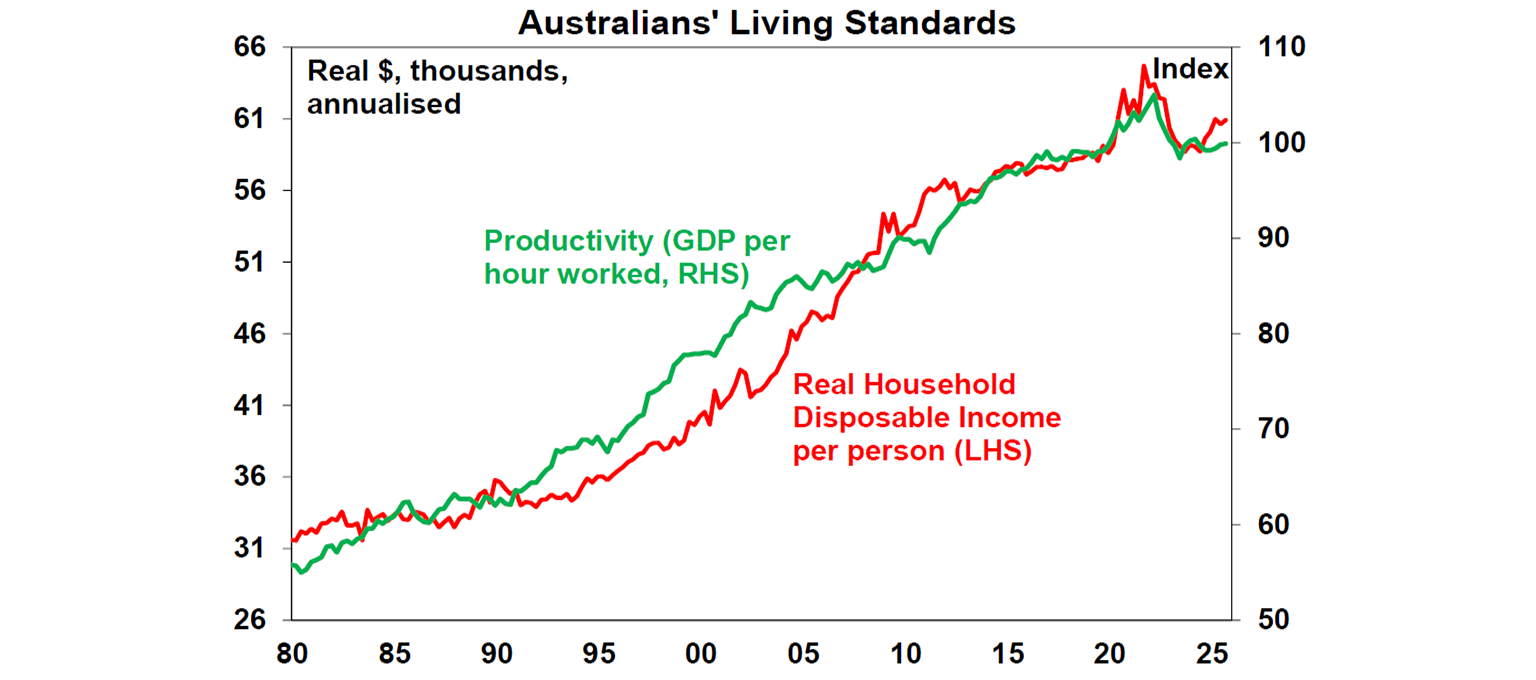
7. Productivity growth underpins rising living standards – over the long run improvements in real incomes depend on rising productivity or output per hour worked — driven by technology, skills and capital.

Source: ABS, AMP

8. Inflation is ultimately a monetary phenomenon – while short term inflation can be impacted by supply and demand shocks, sustained inflation requires money supply growth to exceed real output growth.
9. Short run and long run are different – policies that boost demand can raise employment in the short run, but long-run growth depends on supply-side factors like productivity, incentives, and institutions.
10. Expectations matter – what people think affects current decisions and hence outcomes. For example, if workers and businesses expect inflation to stay low then they will be more likely to set wage and price increases at low levels. This is why central banks want to keep inflation expectations at low levels. Likewise, if businesses expect to be whiplashed by erratic announcements from government about tariffs and how to run their business then they will invest and employ less.

Economic rationalism is out of favour

Starting in the 1980s and rolling into the 2000s these lessons were front and centre of economic policy making as the malaise of the 1970s was fresh and led to a focus on sensible economic policy making drawing on many of these insights – free markets, measures to boost competition, smaller government, free trade, monetary policy focussed on keeping inflation down and attempts to anchor expectations at desired levels. But support for economic rationalism is in retreat. There are several reasons for this:

  • The GFC reduced confidence in free markets. This has been clearly evident in the u turn back towards more state direction in the Chinese economy under President Xi. But also in the increasing intervention in the US economy since President Obama but particularly under Trump.
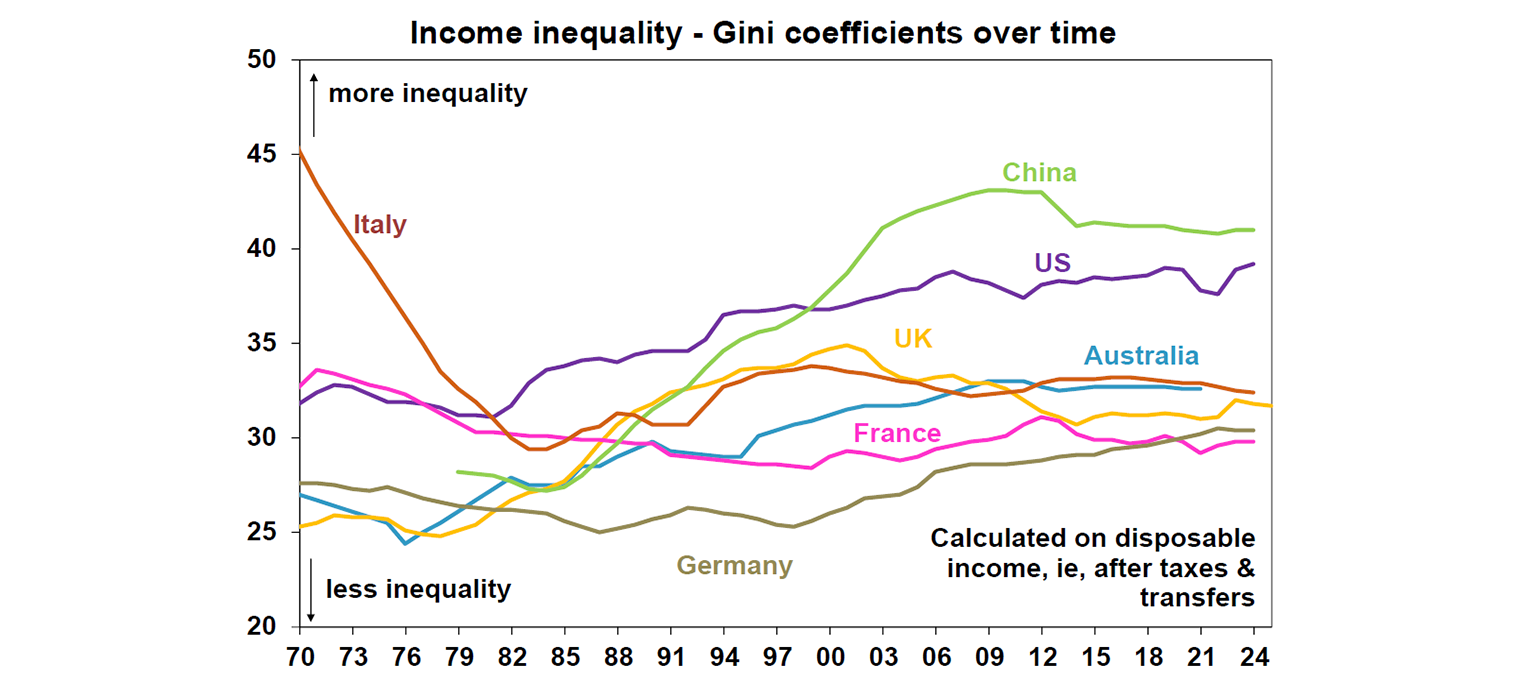
  • The marginal voter now favours more government intervention in the economy – this likely reflects a combination of rising inequality (notably in the US), perceived cost of living pressures, expectations running ahead of reality (with more going to university and coming out with expectations that they will run things), social media driving and aggravating grievance, the experience in some countries through the pandemic where government backstopped jobs and spending and a dimming of memories of the malaise of the 1970s.

The Gini coefficient measures income inequality & shows variation between the actual income distribution and the perfectly equal distribution and ranges between zero or perfect equality and one or perfect inequality. Source: OECD, Standardised World Income Inequality Database, AMP

  • A backlash against high immigration levels has led to a rise in “far-right” nationalist political parties, eg, the National Rally in France, AFD in Germany, the Reform Party in the UK and even Trump in the US.
  • Economic insights are often counterintuitive – surely government is better at directing the use of scarce resources than free markets? Or they are not what people want to hear – eg, that there is no free lunch.
  • Policy makers are less inclined to communicate the need for hard choices reflecting the rise of focus groups driving policy and in the face of social media which amplifies grievance and simplistic solutions.
  • A decline in the study of economics in school and university (in favour of trades like business and finance) may be contributing to increased ignorance of the insights from economics. In Australia economics enrolments in Year 12 are down around 70% on early 1990s levels. The resultant loss of economic literacy may make it harder for people to engage in economic policy debate or resist simplistic populist solutions.

With a loss of faith in the economic system has also come an increasing disregard for the global rules-based order that governed global relations in the post war period for the West and globally since the end of the Cold War. Canadian PM Mark Carney refers to this as a “rupture”. It’s evident in the increasing threat faced by the UN, WTO, the International Court, global efforts to combat climate change, etc. This rules-based order while far from perfect helped reinforce economic rationalist approaches globally, eg in free trade and in the IMF’s assistance to debt ridden countries.

From the age of the economist to the age of the populist

The end result has been a rise in populism. While the far right tends to be dominated by a desire for no or selective immigration, the common features of populists whether left or right are a scepticism of free markets and support for more state direction of and participation in the economy along with protectionism. It’s evident in the US with President Trump where the term “Socialism with American characteristics” is becoming more apt with increasing links between the public and private sectors. It’s evident in the power of the far left and far right in France which is leading to political grid lock. Populism has always been around, but for many years it was on the fringes – but its increasingly taking centre stage. While its impact has been less in Australia it is evident in “Future Made in Australia” policies and the rising tendency for government to prop up struggling steel works and aluminium smelters. Politically, populism has been held at bay in Australia by compulsory voting contributing to a dominance by the centre left ALP and centre right L-NP but this may be coming under threat with the implosion in the Coalition and One Nation now polling ahead of the combined Liberal and National Parties in primary voting intentions.

But populist economic policies tend to fail

The problem is that populist policies offer no sustainable solution to the frustrations people feel and will ultimately make things worse. This is because: by promising more spending and less taxes they ignore budget constraints; by advocating price controls which gives short term relief they worsen things long term by reducing supply (eg, rent controls); they often advocate easy money which invariably leads to high inflation, eg Turkey; they wrongly blame scapegoats like immigrants or institutions like central banks for problems leading to policies that discourage innovation & investment; they go for short term gains (like artificially boosting wages) which leads to long term pain (like unemployment); and their erratic intervention in the economy (eg, raising then cutting tariffs and overriding the rule of law) leads to less investment and employment. And many of Trump’s policies will worsen inequality rather than combat it.

Implications for investors

There are three key implications for investors. First, a less favourable economic outlook – if governments play an increasing role in the economy overriding many of the insights from economics referred to above it’s likely to mean lower productivity over time resulting in slower economic growth and higher inflation than otherwise. In short, lower living standards. Of course, this will take time to show up. In the US at present its being fortuitously masked by the AI boom. Second, the shift to populism and nationalism is leading to increased geopolitical risk which means increased uncertainty. Finally, all of which runs the risk of more constrained and volatile investment returns.

Of course, as an economist I would say the key is to promote the study of economics but of course it’s more complicated! And these things go in cycles with the shift away from economic rationalism to populism likely to have further to go before it’s realised that populism is a dead end.

The investment Outlook for 2026 – expect a rough but, ultimately, ok ride

By Dr Shane Oliver – Head of Investment Strategy and Economics and Chief Economist, AMP Capital | 19 Jan 2026

Key points

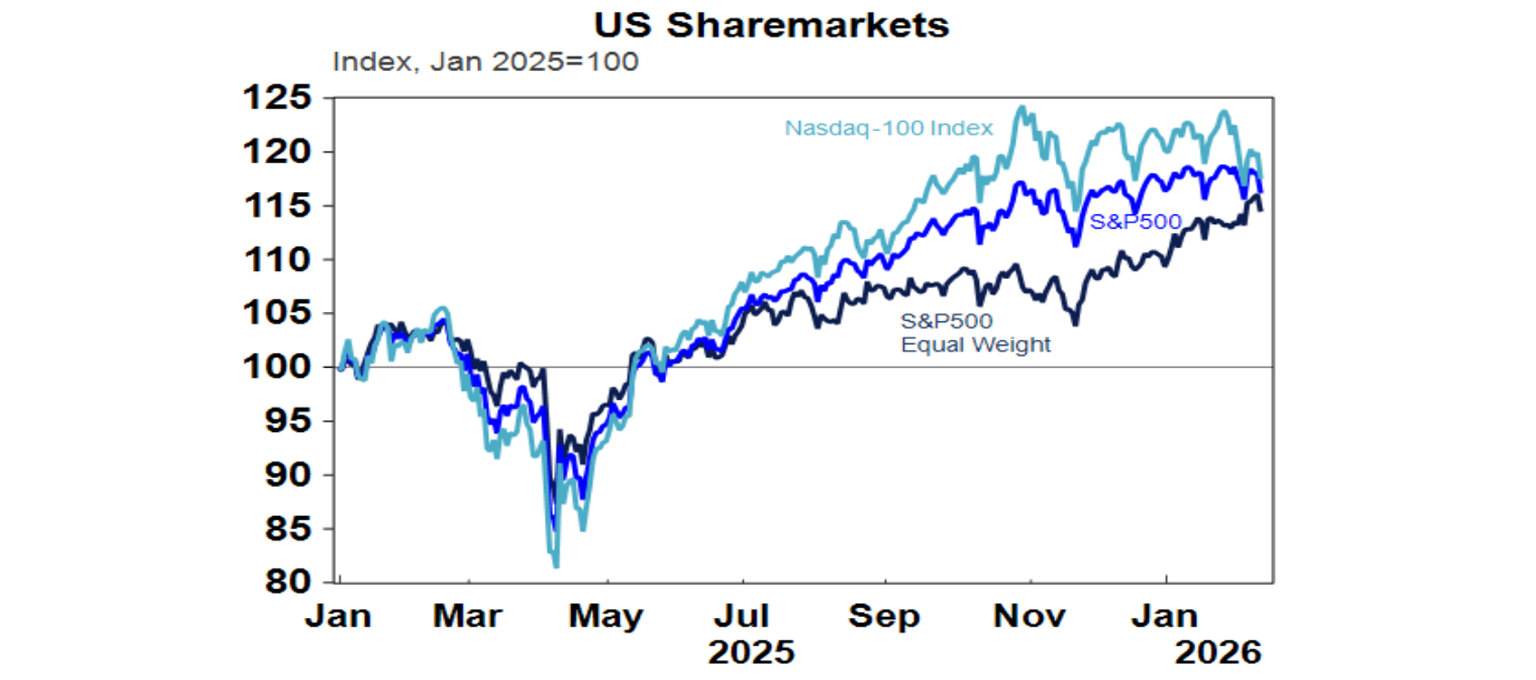
  • 2025 was another strong year for investors with shares up strongly on the back of better than feared growth and profits and global central banks cutting rates. Balanced super funds returned around 9%. Volatility rose though mainly on the back of worries about Trump’s tariffs.
  • 2026 is likely to see good returns but after the strong gains of the last three years, it’s likely to be more constrained. And another 15% plus correction is likely along the way again.
  • We expect the RBA to leave rates on hold, the ASX to return around 8% and balanced growth super funds to return around 7%. Australian home price gains are likely to slow to around 5-7%.
  • The key things to watch are interest rates; the AI boom; US midterms; China; geopolitics; and the Australian consumer.

Introduction

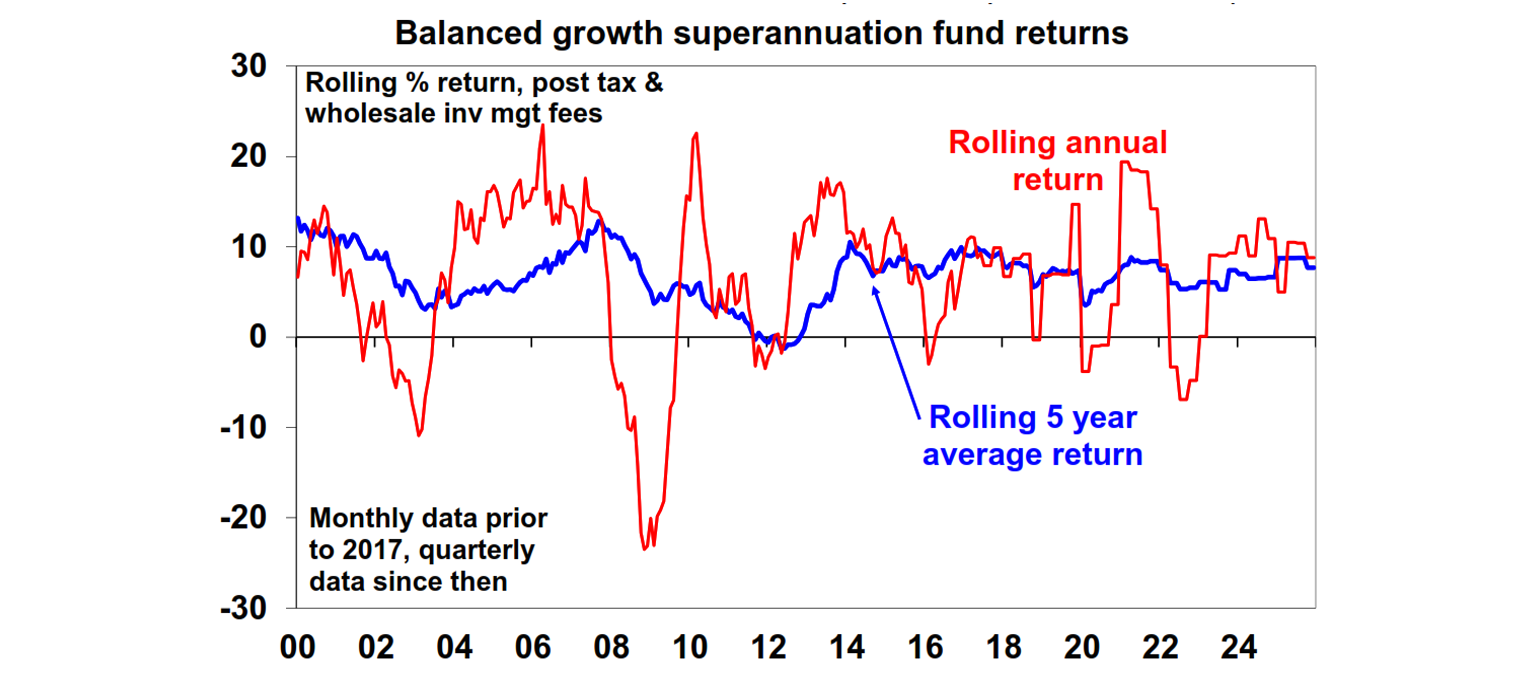
Despite uncertainty around US President Trump’s policies, geopolitics and interest rates, 2025 saw strong investment returns on the back of falling interest rates, solid economic and profit growth globally and expectations for stronger profit growth in Australia. AI enthusiasm boosted US shares although they were relative underperformers globally. This saw average superannuation funds return around 9%. This is the third year in a row of returns around 10% and over the last five years, they returned 7.7% pa.

Source: Mercer Investment Consulting, Morningstar, Chant West, AMP

Here is a simple dot point summary of key insights & views on the outlook.

Five key themes from 2025

  • US tariff turmoil – Trump’s Liberation Day tariffs caused volatility, but fortunately he backed down, retaliation was limited, deals were cut, and a trade war was averted.
  • AI enthusiasm – It surged along with related investment.
  • Global resilience – Despite Trump’s shock and awe global growth remained just above 3% and Australian growth picked up.
  • Lower interest rates – Despite sticky inflation around 3%, central banks continued to cut rates. In Australia rates were cut three times.
  • Gold a “safe haven” – There was lots of geopolitical noise, but it failed to dent investment markets significantly, but it did help gold prices!

Five lessons for investors from 2025

  1. Government intervention in markets is still rising. It was evident under Biden with increasing subsidies, and it’s ramped up dramatically under Trump with tariffs a key example along with the US Government buying shares in companies like Intel and charging Nvidia a fee for selling chips to China. “Socialism with American characteristics” is becoming more apt. In Australia it’s also evident in government moves to prop up failing steel works and aluminium smelters. Ultimately, it will mean a high cost to taxpayers and consumers.
  2. Trump’s bite is often worse than his bark. Variations are “take Trump seriously but not literally” or “Trump always chickens out” (TACO). Trump often puts something out there (like Liberation Day tariffs around 30%) then backs down as markets rebel or deals are cut.
  3. Timing markets is hard. It was tempting to switch out of shares in response to the plunge around Trump’s silly Liberation Day tariffs and on the back of concerns around stretched valuations or an AI bubble. But the trend remained up. As Keynes once said, “markets can remain irrational for longer than you can remain solvent.”
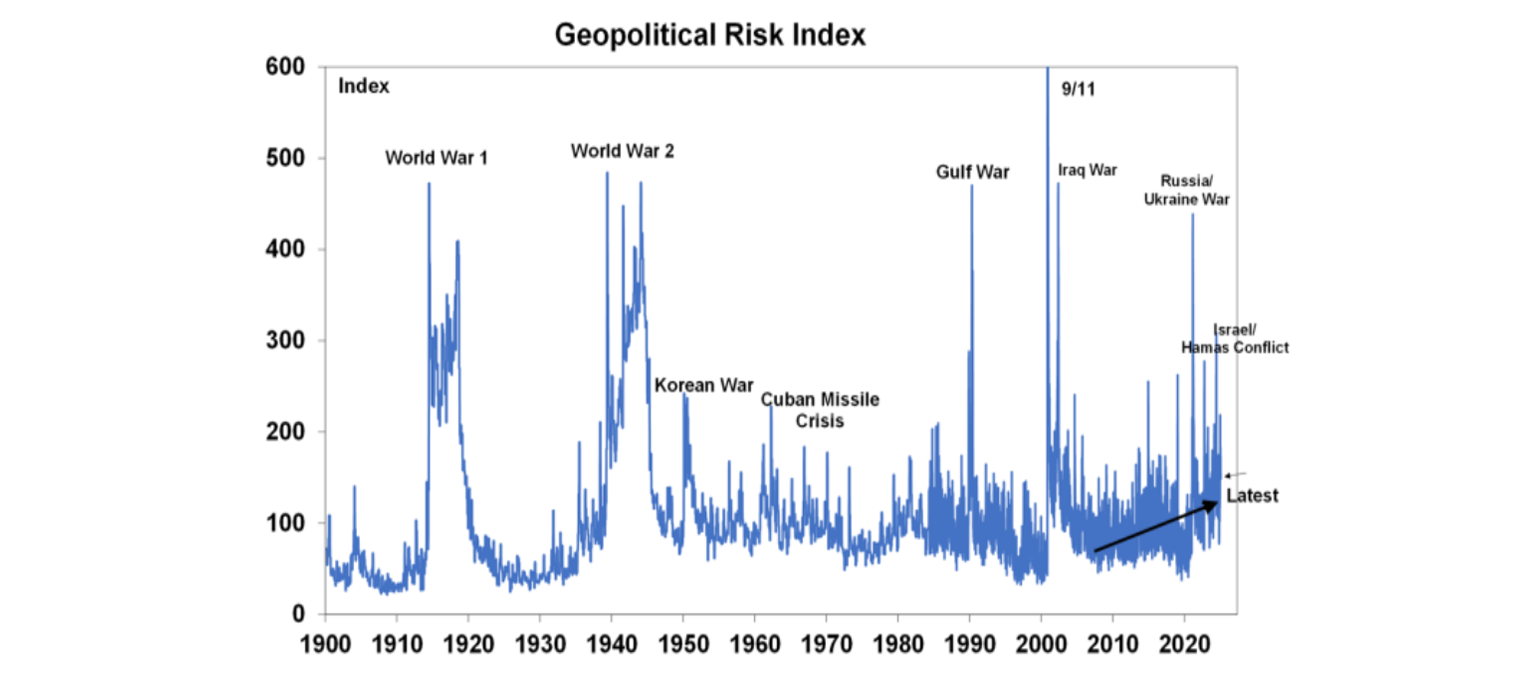
  4. Geopolitical risk remains high in an age of populists and nationalism, and this can create periodic setbacks in markets.
  5. By the same token, geopolitical events are hard to predict & then can be less impactful than feared. There was much fear that a US strike on Iran would lead to a flare up and surge in oil prices, but it was all a bit of a non-event from a market perspective and quickly forgotten about.

Some of these are covered in detail by my colleague Diana Mousina here.

Seven big worries for 2026

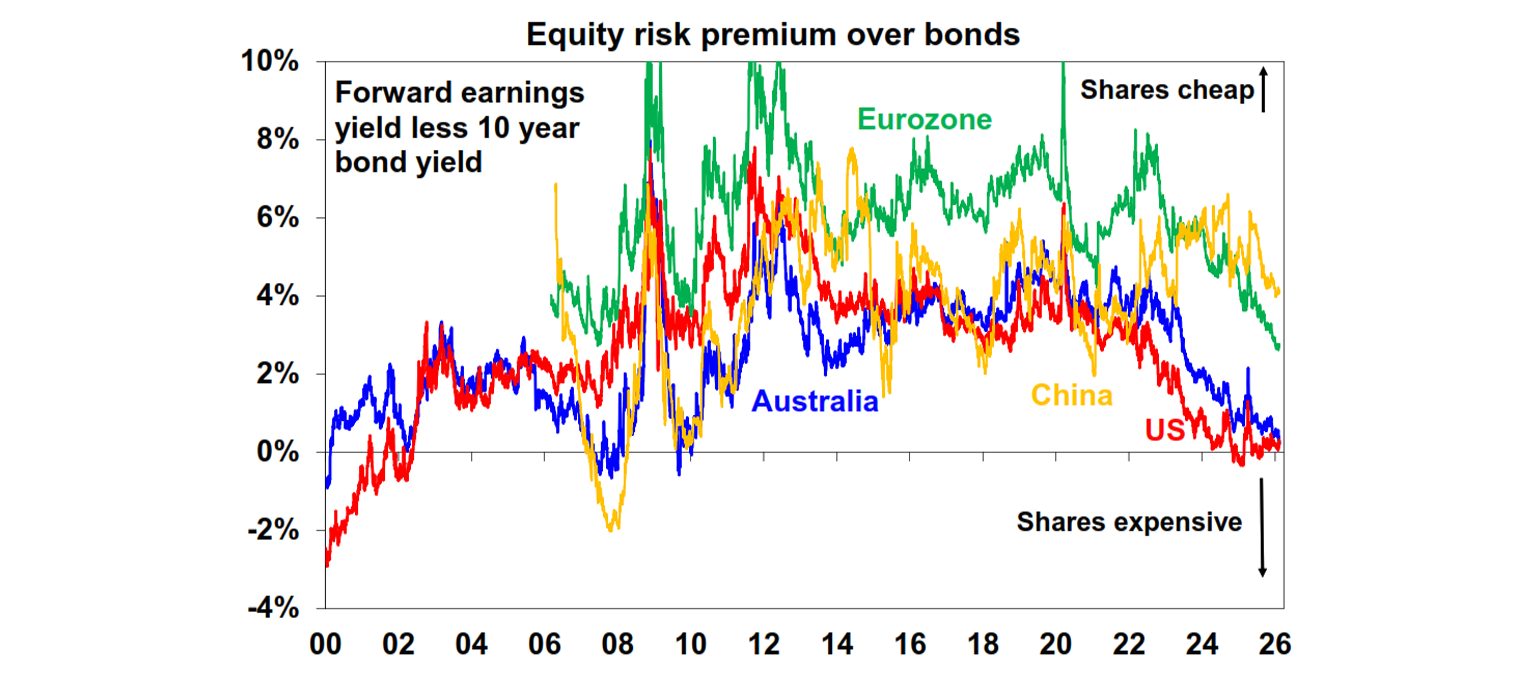
  • Share valuations – these remain stretched relative to history with US shares offering little risk premium over bonds and Australian shares not much better. Fortunately, Eurozone and Asian shares are cheaper.
  • The surge in AI shares shows some signs of being a bubble – including surging data centre capex increasingly being funded by debt.
  • Some central banks are at or close to the bottom on rates – this includes the ECB, Bank of Canada and the RBA. In Australia, higher inflation since 2025 could see the RBA hike prematurely.
  • Trump’s policies – there is much uncertainty about the impact of his policies in relation to tariffs, immigration, university research, the rule of law and his attacks on Fed independence which are hotting up ahead of Chair Powell’s term expiring in May. And now his crazy grab for Greenland to get its minerals and threat of tariffs on Europe if they don’t let him have it. All of which threaten “US exceptionalism.”
  • Risks for China’s economy remain – as its property slump continues.
  • High public debt in the US, France the UK and Japan is a problem – it runs the risk that governments will try and inflate their way out of it.
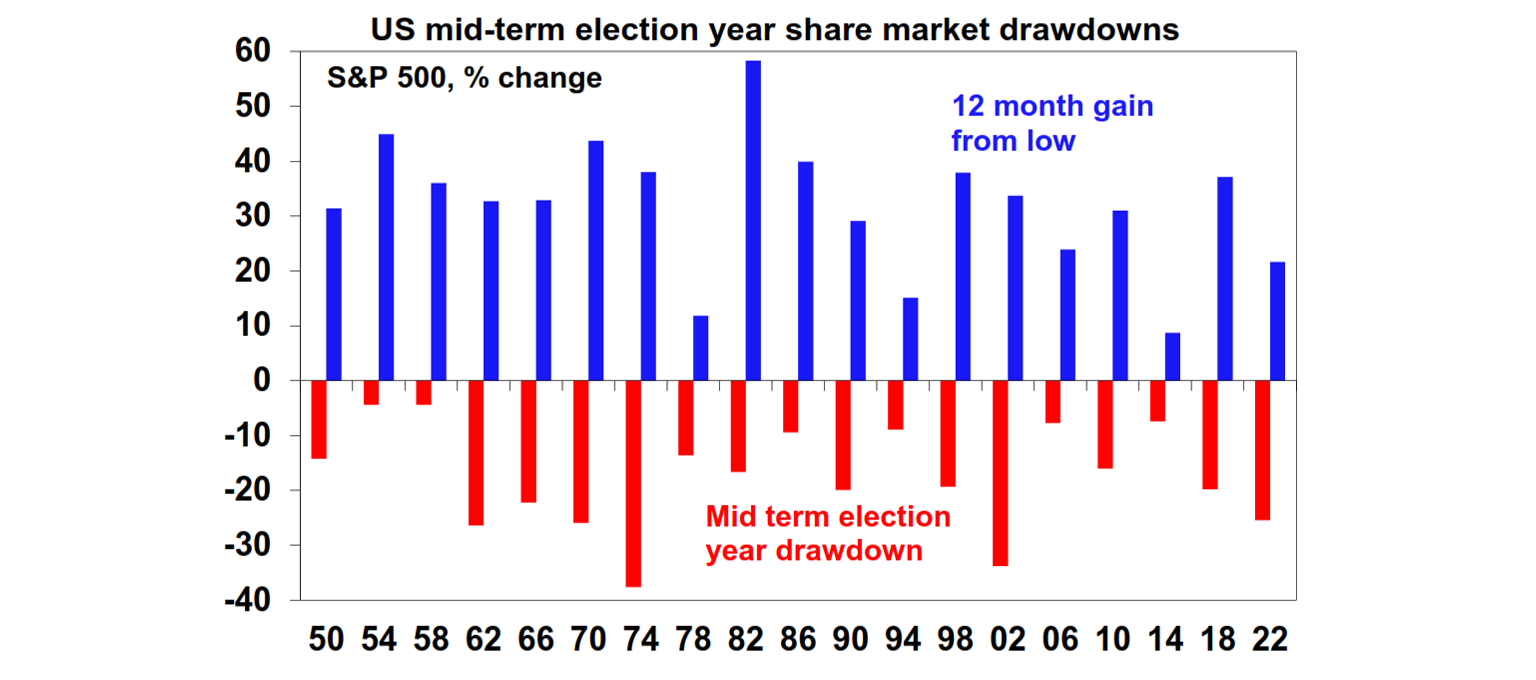
  • Geopolitical risk remains high – the Ukraine war is yet to be resolved, problems with Iran could flare up again with a possible US military strike, US tensions with China could escalate again, political uncertainty will likely be high in Europe with the rise of the far right, the US intervention in Venezuela could turn bad for the US (and may be interpreted as a “green light” for China and Russia to act in their own spheres of influence). Trump’s grab for Greenland threatens the NATO appliance. And the midterm elections in the US are often associated with share market volatility with an average 17% drawdown in US shares in midterm election years since 1950. This is arguably evident in Trump’s increasingly erratic and populist policies.

Source: Bloomberg, AMP

These considerations point to another year of high volatility.

Five reasons for optimism

  1. First, while AI may be in the process of becoming a bubble it could still be early days. Compared to the late 1990s tech bubble: valuations are cheaper; Nasdaq is up less; tech sector profits are very strong; bond yields are lower; and its early days in the associated capex build up around data centres.
  2. Second, while central banks are likely close to the bottom on interest rates, rate hikes are likely a way off (probably a 2027 story). For the Fed, another rate cut is likely in 2026, and a Trump appointee will likely be given some leeway before Fed independence worries really kick in. In Australia we expect some fall back in underlying inflation to allow the RBA to avoid rate hikes, but it’s a close call.
  3. Third, despite lots of noise Trump is pivoting to more consumer-friendly policies ahead of the midterms which will boost demand, and ultimately, he wants shares to rise ahead of the midterms and not fall. There is a chance he could now pivot further towards the populist left. But mostly his shift will likely be more market friendly and given the elections he has an interest in keeping geopolitical flareups low. Pressure to reduce the cost of living suggest the threatened tariffs on Europe over Greenland are a bluff & won’t stick.
  4. Fourth, global growth is likely to stay just above 3% as the lagged impact of rate cuts feed through along with some policy stimulus in the US and China. Australian growth is likely to edge up to 2.2%.
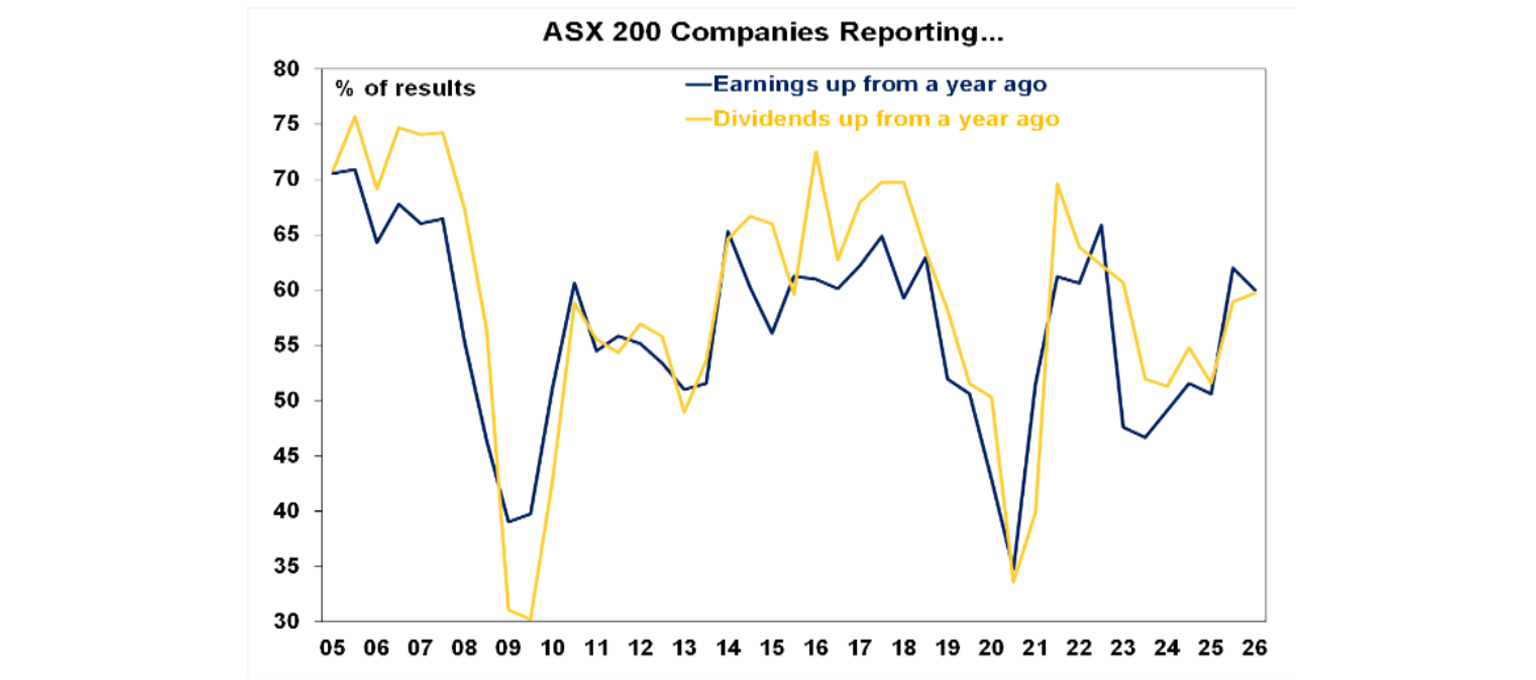
  5. Finally, okay economic growth likely means solid profit growth globally & about 10% profit growth in Australia (after 3 years of falls).

Key views on markets for 2026

  • After three years of strong returns, global and Australian share returns are expected to slow in the year ahead to around 8%. Stretched valuations in the key direction setting US share market, political uncertainty associated with the midterm elections and AI bubble worries are the main drags, but returns should still be positive thanks to Fed rate cuts, Trump’s consumer friendly pivot and solid profit growth. A return to profit growth should also support gains in Australian shares. Another 15% or so correction in share markets is likely along the way though.
  • Bonds are likely to provide returns around running yield.
  • Unlisted commercial property returns are likely to stay solid helped by strong demand for industrial property for data centres.
  • Australian home price growth is likely to slow to around 5-7% in 2026 after 8.5% in 2025 due to poor affordability, rates on hold with talk of rate hikes & APRA’s ramping up of macro prudential controls.
  • Cash & bank deposits are expected to provide returns around 3.6%.
  • The $A is likely to rise as the rate gap in favour of Australia widens as the Fed cuts & the RBA holds or hikes. Fair value is about $US0.73.
  • Precious metals like gold are likely to remain strong as a hedge against Trump related inflation risks and geopolitics.
  • Balanced super fund returns are likely to be around 7%.

Six things to watch

  1. Interest rates – if underlying inflation fails to fall, central banks including the RBA could start hiking rates.
  2. The US midterms – historically these drive more volatility in markets & uncertainty is high this time around given Trump’s erratic approach.
  3. The AI boom – watch for signs that it may be becoming more bubble like with investor euphoria and excessive debt driven capex.
  4. The Chinese economy – China’s property sector is continuing to struggle, and more measures are needed to support consumers.
  5. Geopolitics – risks remain high on several fronts including the US/China détente, Iran, Ukraine and now Greenland.
  6. The Australian consumer – consumer spending has seen a decent pick up but may be vulnerable if rates start to rise.

Nine things investors should always remember (yeah, I know I say this every year, but they are important!)

  1. Make the most of compound interest to grow wealth. Saving in growth assets can grow wealth significantly over long periods. Using the “rule of 72”, it will take 16 years to double an asset’s value if it returns 4.5% pa (ie, 72/4.5) but only 9 yrs if the asset returns 8% pa.
  2. Don’t get thrown off by the cycle. Falls in asset markets can throw investors off a well-considered strategy, destroying potential wealth.
  3. Invest for the long-term. Given the difficulty in timing market moves, for most it’s best to get a long-term plan that suits your wealth, age and risk tolerance and stick to it.
  4. Diversify. Don’t put all your eggs in one basket.
  5. Turn down the noise. We are increasingly hit by irrelevant, low quality & conflicting information which boosts uncertainty. The key is to avoid the click bait, turn down the noise and stick to a long-term strategy.
  6. Buy low, sell high. The cheaper you buy an asset, the higher its prospective return will likely be and vice versa.
  7. Avoid the crowd at extremes. Don’t get sucked into euphoria or doom and gloom around an asset.
  8. There is no free lunch! If an investment looks dodgy, hard to understand or has to be justified by odd valuations, then stay away.
  9. Seek advice. Investing can get complicated.